Pearl jewelry has a familiar polish, but it does not belong only with a special-occasion dress. A small shift in proportion, texture, or color can make pearls feel at home with a cotton shirt, a soft sweater, or the pieces already in your weekly rotation. A useful starting point for pearl jewelry is an outfit you already reach for. The idea is not to make an outfit look dressed up; it is to let a little luster bring focus to clothes you genuinely enjoy wearing.
Start with the mood you want: a neat pearl stud can quietly finish a workday look, while a strand with varied shapes can feel relaxed and individual. From there, think about neckline, fabric, and the amount of contrast your outfit needs. These simple choices make pearl jewelry feel personal rather than precious, and help you reach for it far beyond celebrations.
Begin with the outfit, not the occasion
An easy way to wear pearls is to start with a reliable outfit and add only one point of shine. Try a white or pale-blue button-down with the collar open, straight-leg jeans, and a short pearl necklace. The combination keeps the shirt’s clean lines but softens them. Here, pearl jewelry adds a focal point without changing the outfit’s casual character. With a crew-neck tee, a strand that sits just above the collar adds definition without asking the rest of the outfit to change.
For a relaxed knit, consider the scale of the weave. A fine chain or a few small pearls can slip into the texture of a lightweight ribbed top, while a chunkier strand stands out more clearly against a smooth, close-fitting sweater. If your knit is already lofty or heavily textured, a simple earring may be the more comfortable choice; it gives the face a little light without competing with the fabric. This is where pearl jewelry can bridge dressy and relaxed textures with very little effort.
Think of pearl jewelry as a finishing detail, not a uniform. On a casual day, a single element—necklace, earrings, or a bracelet—often feels most natural. If you like a coordinated effect, repeat a tone rather than an exact set: creamy pearls with a warm neutral top, or cool white pearls beside gray, navy, and crisp cotton. A deliberate echo is subtle; matching every accessory can make an everyday outfit feel more formal than intended. The best pearl jewelry is defined by how naturally it works with your clothes, not by formality.
Use the neckline as a practical guide. A short necklace works well with an open collar or a lower scoop, while a longer line can create a clean vertical accent over a simple crew neck. If you are layering, let the lengths separate visibly so each strand has room. Our necklace collection is a useful place to compare different silhouettes; focus on how a piece would sit with the necklines you actually wear. For everyday pearl jewelry, scale and placement matter more than a strict dress code.
Play with scale, texture, and a little contrast
Modern everyday styling often comes down to contrast. Pearls have a smooth, light-catching surface, so they look especially appealing beside fabrics with a different hand: washed denim, linen, cotton poplin, soft jersey, or a substantial knit. That difference keeps an outfit from feeling too polished. A pearl necklace over a plain T-shirt, for instance, gains an easy edge from the casual fabric beneath it. That tension is what lets pearl jewelry look at home alongside familiar basics.
Scale matters as much as material. Small pearls give a quiet accent and work well when your clothes already have a print or strong shape. A larger pearl or a strand with noticeably varied beads becomes a focal point, so give it a little visual breathing room: choose a solid top, keep the neckline uncomplicated, and let the jewelry lead. Neither approach is more correct; choose based on whether you want the detail to whisper or to be noticed. Choose pearl jewelry by presence, not by a presumed occasion.
For a simple experiment, keep the outfit constant and switch one piece. Wear your usual white shirt with small pearl drops one day, then try a bolder hoop or a more substantial necklace another. Notice how the whole look changes, even though the clothes do not. This is a useful way to understand what feels like you before adding more layers or buying something new.
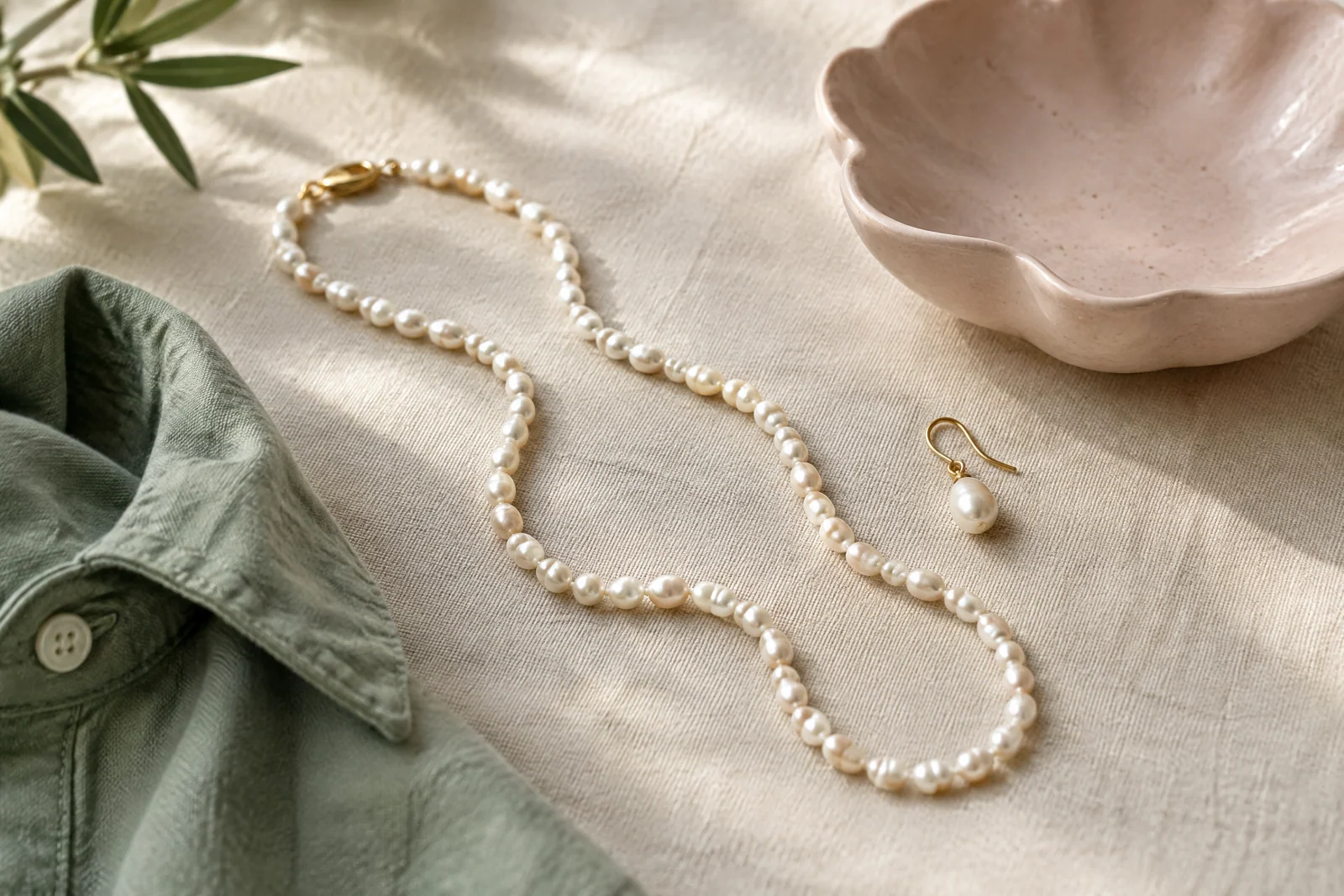
Freshwater pearls are naturally individual in outline and surface, while faux pearls are designed to offer a pearl-like look; the product description is the place to confirm which material is used. These terms are not interchangeable. Clear product descriptions make it easier to choose pearl jewelry by both material and appearance. If you enjoy a little variation, look for a product description that identifies freshwater pearls and notes that shapes may differ. If you prefer a more uniform appearance, compare the actual product details and imagery before choosing. Pearl jewelry can be polished or playful in either material, but knowing the distinction helps set expectations.
A useful example from the collection is Lisbon Pearls, described as a necklace using two sizes of freshwater pearls with a chunky plated clasp and 14k gold-fill details. Its approximately 45-centimeter length gives it a modern, easy-to-layer profile. For a more compact focal point, Rafa pairs a single freshwater pearl with a textured chain and is described as sitting close to the neck. Treat those details as styling cues: one has a softly varied strand, the other a singular accent. Either can make pearl jewelry an uncomplicated companion to a shirt or knit.
Use color to make pearls feel like you
Pearls do not have to be reserved for a palette of black, cream, and navy. Their soft sheen can balance saturated color, bring calm to a print, or pick up a pale tone already in an outfit. Color gives pearl jewelry a fresh direction without asking for a new wardrobe. With sage, blush, or sky blue, a creamy pearl creates a gentle tonal combination. Against red, cobalt, or forest green, it reads more clearly as a light accent. Try the piece against the actual fabric in daylight if you are unsure how warm or cool the overall effect feels.
For an especially easy formula, choose one color family and let the pearl be the quiet neutral. A sage shirt, medium-wash denim, and pearl earrings feel considered without being overly coordinated. Or wear a coral knit with a simple necklace, allowing the contrast between color and luster to do the work. If your clothes have several colors, pick one that appears near the face and echo it in another small detail, such as a bag or shoe. The jewelry can stay simple. Used this way, pearl jewelry becomes a repeatable part of getting dressed.
Metal color can help connect pearls to the rest of your accessories. Gold-toned details tend to harmonize with warm creams, tans, and earthy shades; silver-toned details can feel crisp with gray, blue, or bright white. But this is a starting point, not a rule. Either metal can suit everyday pearl jewelry; repetition elsewhere is the useful clue. Mixed metals can look intentional when repeated elsewhere, perhaps in a watch, a belt buckle, or a second necklace. Let one repeated detail create a bridge and the difference will feel considered.
There is also room to play with earring shape. A small pearl drop can bring a soft detail to a bright blouse, while a pearl-accented hoop creates more structure with a T-shirt or an open-neck shirt. The Effie hoops are described as gold-plated stainless-steel hoops with freshwater-pearl charms, and the pearls may vary slightly in appearance. That variation can make a simple outfit feel less pristine and more lived-in. Browse the wider earring collection for silhouettes that suit how much movement and presence you enjoy. A well-chosen pair makes pearl jewelry feel personal rather than reserved for formal plans.
When you are dressing quickly, use a three-part check: the neckline, the dominant color, and the outfit’s texture. Choose one piece that responds to one or two of those features, not all three. A pearl drop beside an open collar may be enough; a short strand against a plain knit may already supply texture and focus. This small edit keeps pearl jewelry from feeling like an afterthought or an extra layer added simply because it is there.
Keep your favorites wearable and cared for
Everyday wear begins with comfort and confidence. Notice whether a necklace sits where you expect when you move, whether an earring feels balanced, and whether the clasp is easy for you to manage. Product measurements can help you estimate scale, but fit is personal: compare a listed length with a necklace you own, or hold a piece against a similar neckline. If you prefer a lighter visual impression, choose a single accent or smaller scale; if you enjoy a more expressive look, let one bolder piece anchor the outfit.
Layering can be easy when each piece has a clear role. Pair a short necklace with a longer, simpler chain, leaving enough distance that the two do not crowd one another. Keep the textures distinct—perhaps pearls alongside a fine chain—and avoid adding several focal pendants at once. If the layers shift or tangle through the day, edit them down. A comfortable pair of pearl jewelry pieces worn often is more useful than an ambitious combination you keep adjusting.
Care depends on the materials in the individual piece, especially when pearls sit alongside plated metal, chain, cord, or other components. For practical wear, pearl jewelry benefits from simple attention to the materials. As a gentle routine, remove jewelry before applying perfume, lotion, or hair products, and wipe it with a clean, soft cloth after wear. Store it separately so harder pieces do not rub against the pearls or delicate finishes. Avoid soaking mixed-material jewelry or using a strong cleaner unless the product’s specific care guidance says it is appropriate. If something needs more than a light wipe, check the maker’s instructions rather than improvising with household products.
Small habits help keep a favorite in rotation: fasten necklaces before storing them, give each piece its own pouch or compartment, and check clasps periodically for visible wear. For pearls in particular, gentle handling and dry storage are sensible defaults, but do not assume that every pearl-like material has identical needs. A product may use freshwater pearls, faux pearls, or mother-of-pearl, and the surrounding metal may have its own care considerations. When in doubt, identify the materials first and ask for guidance rather than using an all-purpose cleaning method.
Most of all, let pearl jewelry adapt to your day. A necklace can move from a striped tee to a button-down; a pair of pearl hoops can soften a tailored jacket one morning and add a small point of light to a relaxed weekend outfit the next. Try one new pairing with pieces already in your wardrobe, take a quick mirror check in natural light, and keep what feels comfortable. That is how a classic becomes personal: not by saving it for the perfect moment, but by letting it join the ordinary ones.
Related reading
For more coastal-minded inspiration, explore Coastal Jewelry: Bringing a Little Seaside into Your Style, styling notes in Shell Jewelry: Natural Variation and Styling Ideas, and the playful perspective of Fish Necklaces: A Playful Motif with Everyday Appeal.