A favorite handbag often does its job beautifully but says very little about the person carrying it. Bag charms offer a small, changeable way to add color, memory or a little wit—without replacing the bag or building an entirely new outfit around it. The difference between a personal finishing touch and a jingly jumble usually comes down to editing: one clear idea, a considered place to attach it and enough breathing room for the bag to remain itself.
Think of the charm as a punctuation mark, not a second handbag. It can echo a favorite color, soften a structured shape or make a practical everyday tote feel more individual. Start with the bag you actually reach for, not an imagined perfect look; then choose details that suit its size, material and daily use. Whether you are working with a single bead, a playful token or a short strand of mixed elements, a little intention makes bag charms feel polished rather than overdone.
Choose one clear point of view
Before attaching anything, decide what you want the detail to do. A bag charm might add a cheerful color note, bring a softer texture to a tailored bag, or carry a tiny reminder of a place or person. Naming that purpose is a useful filter. If every item you pick serves a different mood, the result can feel scattered; if the pieces share one idea, even a playful combination looks deliberate.
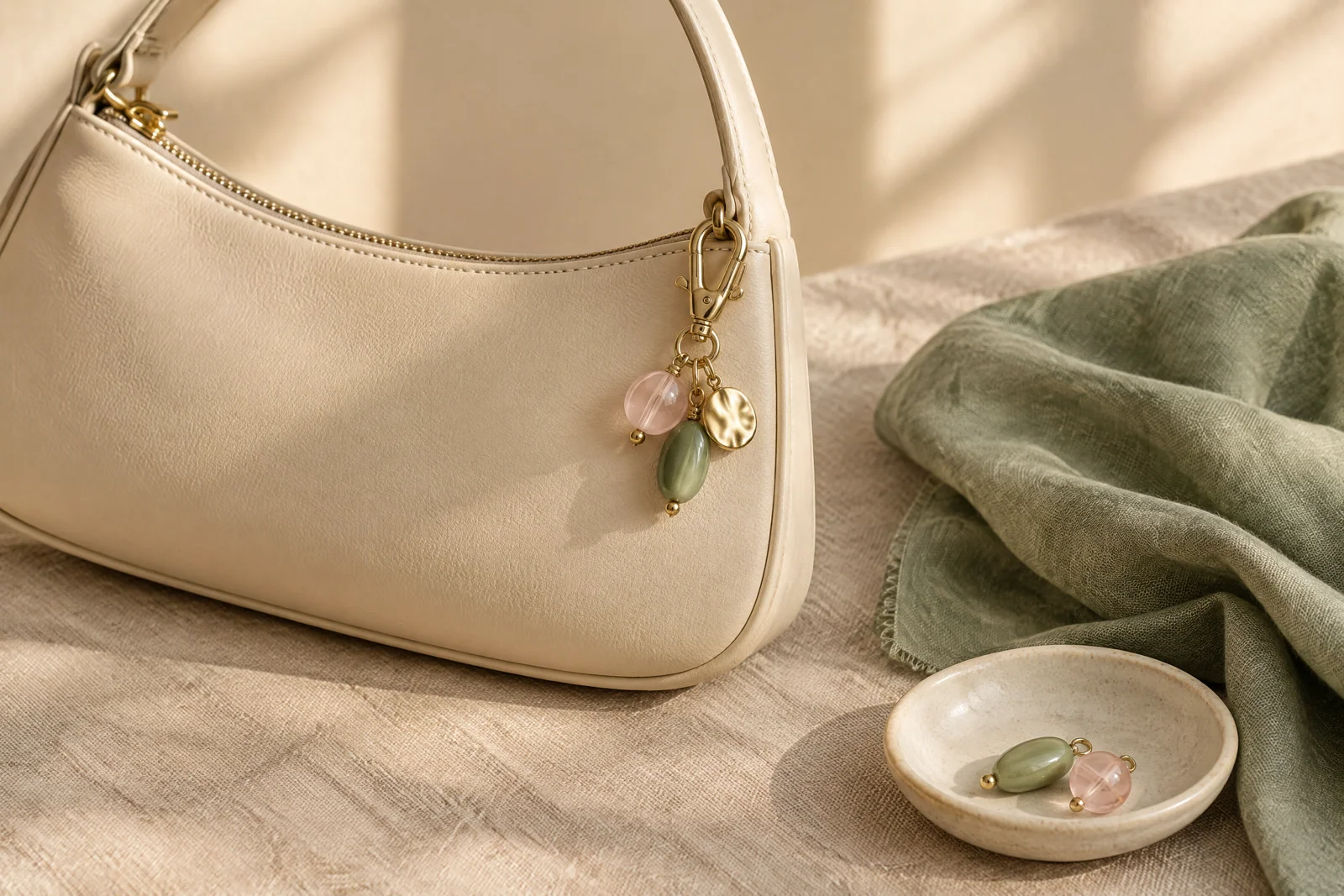
A simple starting formula is one main charm with one supporting detail at most. The main element in bag charms should be legible at a glance: perhaps a colored bead, a sculptural shape, a tassel or a small cluster. A secondary element can repeat its color or material without competing for attention. You do not need a matching set. Repeating just one visual note—warm gold hardware, a particular shade of green, or a rounded silhouette—often creates enough connection.
Let the bag’s existing hardware join the conversation. A bag with prominent metal buckles already has shine and visual detail, so a soft fabric or matte bead may balance it better than a second heavy chain. On a plain canvas tote, a brighter charm can provide the focal point. On a patterned bag, borrow one color from the print and keep the charm compact. The goal of bag charms is not strict coordination; it is a relationship that looks considered from a few steps away.
Color in bag charms can be expressive without becoming complicated. Choose a tone already present in your wardrobe, repeat a quiet neutral from the bag, or use one contrasting accent against a calm base. Blush against cream reads gentle; sage beside warm tan feels grounded; a vivid color against navy or black becomes a deliberate pop. If you are unsure, hold the charm beside the bag in daylight and ask whether your eye lands on the whole arrangement or gets caught on unrelated details.
Balance scale, color and movement
When styling bag charms, scale is the first practical edit. A long or substantial charm can overwhelm a compact crossbody, while a tiny accent may disappear against a roomy tote. As a rough visual guide, let the charm occupy a small part of the bag’s front or side rather than spanning its full width. Imagine the bag as the frame: the decoration should be visible within it, not take over the frame. If the bag has a narrow strap, choose a lighter, shorter piece so the strap still reads cleanly.
Movement matters with bag charms, too. A dangling charm catches the eye and can swing as you walk; that lively quality is part of its appeal, but excess length can knock against the bag or brush your hand. Try carrying the bag for a minute before deciding. Sit, walk, reach for the closure and check whether the charm tangles with the strap, taps a delicate surface or gets in the way of the opening. A smaller piece placed near the handle base may be easier to live with than a long drop at the side.
When you want a layered look with bag charms, vary form rather than simply adding more. One bead strand beside a small smooth token has more contrast than several similar strands of equal length. Mix a rounded shape with a flat one, or a soft textile with a little metal shine. Keep one dominant color and let the rest act as supporting notes. A useful stop rule for bag charms: if you need to explain how all the parts belong together, remove one and look again.
For inspiration, Duddingtons’ Bag Charm #9 is described as pre-loved beads with a silver push-opening ring, made with pre-loved materials, silver-plated mixed metal and sterling silver; it measures approximately 16 cm. Bag Charm #8 is a slightly longer example at approximately 17 cm, also with pre-loved beads and a large silver push-opening ring. These are useful examples of how length, visual weight and the attachment itself can shape the look. Details are drawn from the product descriptions; check each product page for its current listing information.
For more ways to browse accessories, explore the accessories collection. Looking at a range of silhouettes can help you clarify what suits your own bag: a short, compact drop feels neat and contained, while a longer strand creates more motion and a stronger focal point.
Place it thoughtfully and keep it practical
Attachment is part of styling bag charms, not an afterthought. First look for a sturdy handle loop or dedicated hardware that can support the charm without stretching or distorting. A clasp or ring should close fully and sit securely; give it a gentle tug before you head out. If you are styling bag charms on a bag with no obvious ring, a handle base may work, but avoid fastening onto a delicate edge, a thin zipper pull or a section that bears the bag’s weight. The charm should decorate the bag, not become a structural point.
Placement changes the impression a bag charm makes. Near the handle, a charm feels easy to notice and keeps the detail close to the hand. On the side hardware, it can make a quiet accent that does not interrupt a clean front panel. Near a zipper, it may be convenient to grasp, but only if it does not interfere with the closure or snag the lining. Check that it will not catch on hair, clothing, seatbelts or other straps during ordinary movement.
Consider the surface as carefully as the bag charm attachment. A metal ring rubbing repeatedly against soft leather may leave marks over time, while a rough or sharp edge can catch woven fabric. If the contact point feels abrasive, choose another location or add a soft barrier designed for the bag rather than forcing the fit. Avoid loading a lightweight handle with a heavy cluster. When traveling or setting the bag down in a crowded place, a removable charm is easier to protect if you detach it and store it separately.
Bag charms can also become a useful point of recognition, but it should not compromise security. Keep it clear of the opening so it does not slow access to your essentials or hold a zipper ajar. On a bag you carry in busy settings, avoid a long dangling piece that can snag or swing beyond the bag’s outline. These are practical judgments, not strict rules: test the setup with your own bag and habits, and remove anything that feels distracting or inconvenient.
Material variety in bag charms asks for a little care. Beads, textile, leather, plated metal and other components may respond differently to moisture, friction and cleaning products. Do not assume that a charm can be soaked or cleaned with the same method as the bag. Follow the care guidance for each material when available, keep the piece away from harsh cleaners, and wipe gently with a soft dry cloth when appropriate. For a mixed-material charm, the more delicate element should guide how gently you handle it.
Make the charm feel like yours, not like clutter
The most convincing bag charms are personal in a way that still feels easy to wear. That might mean a favorite color, a small keepsake, a playful motif or an object that connects to a hobby. Personal does not have to mean precious: you can change the detail with the season, your plans or simply your mood. The best choice is the one you enjoy seeing on a bag you already use.
Try styling bag charms against your real-life outfits. If most of your clothes are quiet, a bright charm can be a welcome point of energy. If your wardrobe is already full of pattern and color, a restrained metal or tonal detail may feel more natural. Think about the colors near the bag too: a coat, scarf or sleeve can sit beside the charm and change how its color reads. A test in the mirror, with the bag worn as usual, is more helpful than evaluating the charm alone on a table.
There is no requirement to keep bag charms attached every day. A removable piece lets you personalize a plain tote for a weekend, then return the bag to a simpler look for work or travel. If you rotate several favorites, store them separately so strands do not tangle and metal parts do not rub against delicate beads or surfaces. Give the clasp a quick visual check when you put it on and take it off; small, regular attention is easier than discovering a loose connection after a busy day.
For a compact edit of bag charms, choose one bag and try three versions: a single-color accent, a texture-led piece and a small meaningful object. Photograph each on the bag you plan to carry. Looking at the images side by side makes it easier to notice when a charm hides the bag’s shape or competes with its hardware. Keep the version that feels like an addition rather than an interruption. You can find more personality-led pieces in accessories, or explore necklaces and earrings for ideas about color, proportion and combinations you might adapt to your own styling.
When in doubt, take one piece off. A little negative space gives the eye somewhere to rest and lets the bag, the charm and the person carrying it all have a place. That small edit is often what makes bag charms feel intentional: not a display of everything you like, but one thoughtful detail that makes an everyday object feel more like your own.
Related reading
For more color and character, read Coastal Jewelry: Bringing a Little Seaside into Your Style, explore Shell Jewelry: Natural Variation and Styling Ideas, and discover Fish Necklaces: A Playful Motif with Everyday Appeal.