The best day-to-night jewelry plan is the one you can actually use at 5:30 p.m.—not a second look that requires a suitcase, a mirror, and a complete outfit change. A few well-chosen pieces of day-to-night jewelry can shift the mood of what you already have on, whether dinner is a spontaneous catch-up or a reservation you have been looking forward to all week. The trick is to build a calm, comfortable base for the day, then make one deliberate change that feels like you. Think about scale, color, and where a piece sits against your clothes; more is not automatically more polished. These five formulas turn day-to-night jewelry into a simple styling habit, with practical ideas for a desk drawer, a tote, or a quick stop at home.
1. Keep the daytime base, then add one focal point
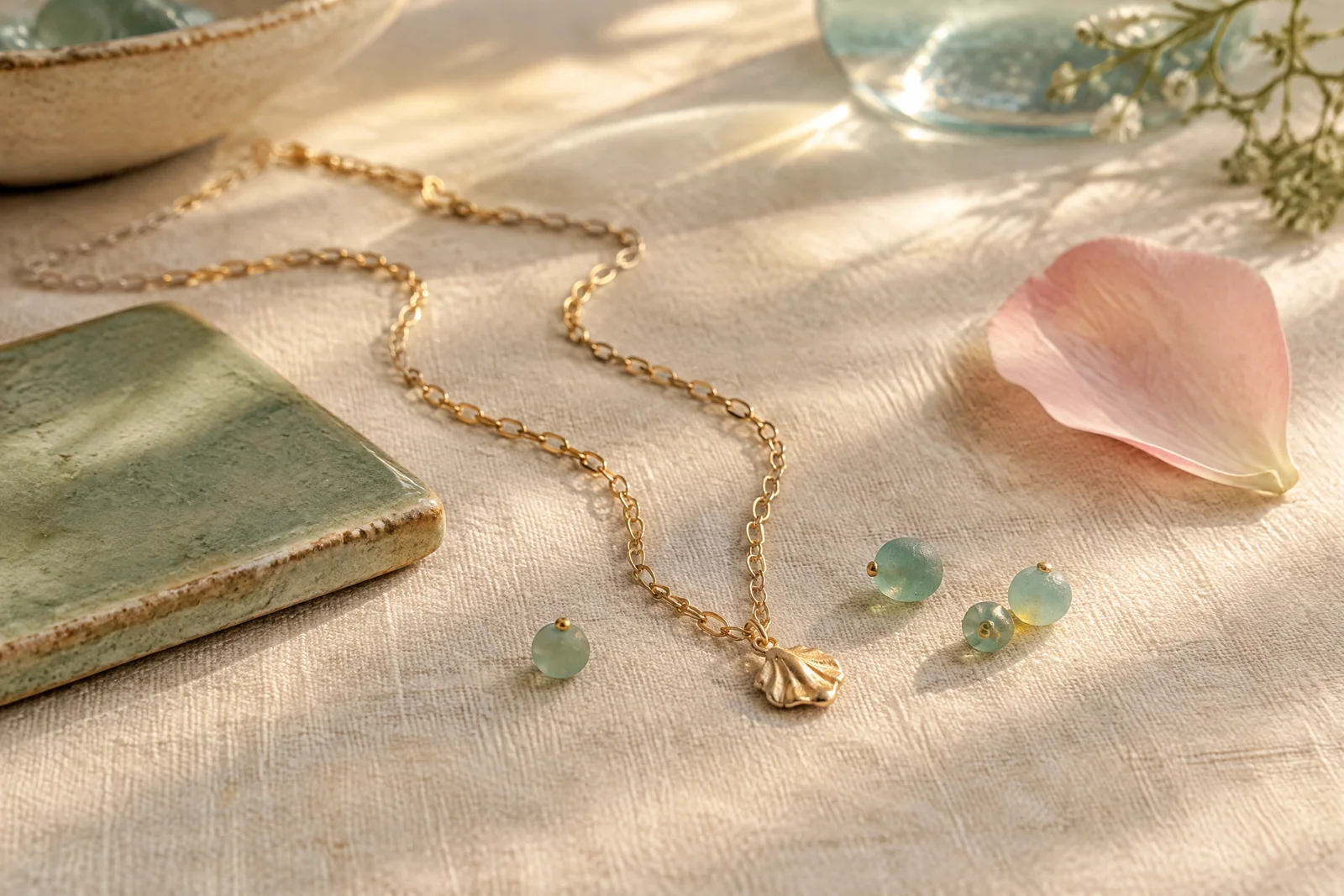
Start with the jewelry you can wear through meetings, errands, and a commute without fuss: perhaps small hoops, a fine chain, or a single bracelet. For evening, leave that foundation in place and add one piece with a little more presence. A pendant with an expressive shape, a brighter bead, or a more substantial earring gives the eye somewhere to land while the rest of the outfit stays uncomplicated. This is the most reliable day-to-night jewelry formula when there is no time to rethink everything. A good day-to-night jewelry plan builds on what you are already wearing, rather than asking you to start over.
Let your neckline guide the focal point. With a crew neck or buttoned collar, earrings may be the easiest way to create definition. With an open neckline, a necklace can do the work without competing with a collar or lapel. If you choose a necklace, check where its pendant falls against the top: a focal detail that disappears under a collar will not feel intentional. A simple, unpatterned layer gives a more detailed piece room to register.
For a real-world example of the shift in scale, Duddingtons' Lyon hoops are described in the catalog as gold-plated stainless steel, with medium and large options measuring 24 mm and 28 mm. You might keep a quieter pair on during the day and pack the larger size for later, or wear the larger hoops from morning onward if they feel comfortable with your routine. The useful principle is not that every dinner needs a bold earring; it is that one clear focal point often reads more composed than several competing statements. Browse the wider earrings collection for different shapes and scales.
When planning day-to-night jewelry, consider the practical transition as well as the visual one. If you will be carrying a change, place it in a small pouch so it does not catch on keys or tangle with a charging cable. Try the complete combination once before the day you need it. A quick test reveals whether an earring feels too heavy for a long stretch or whether a necklace sits comfortably over your work top.
2. Let one color change the temperature of an outfit
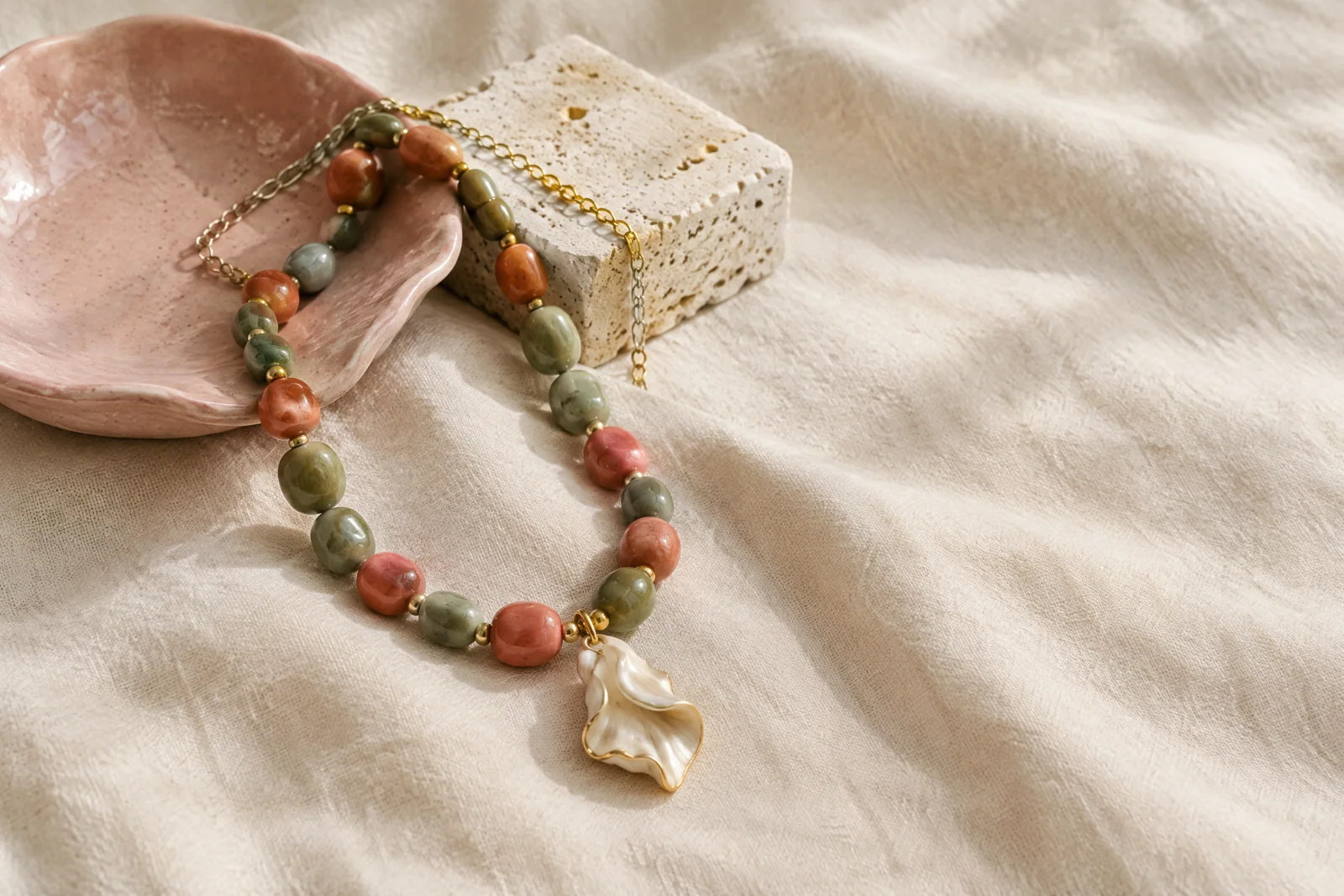
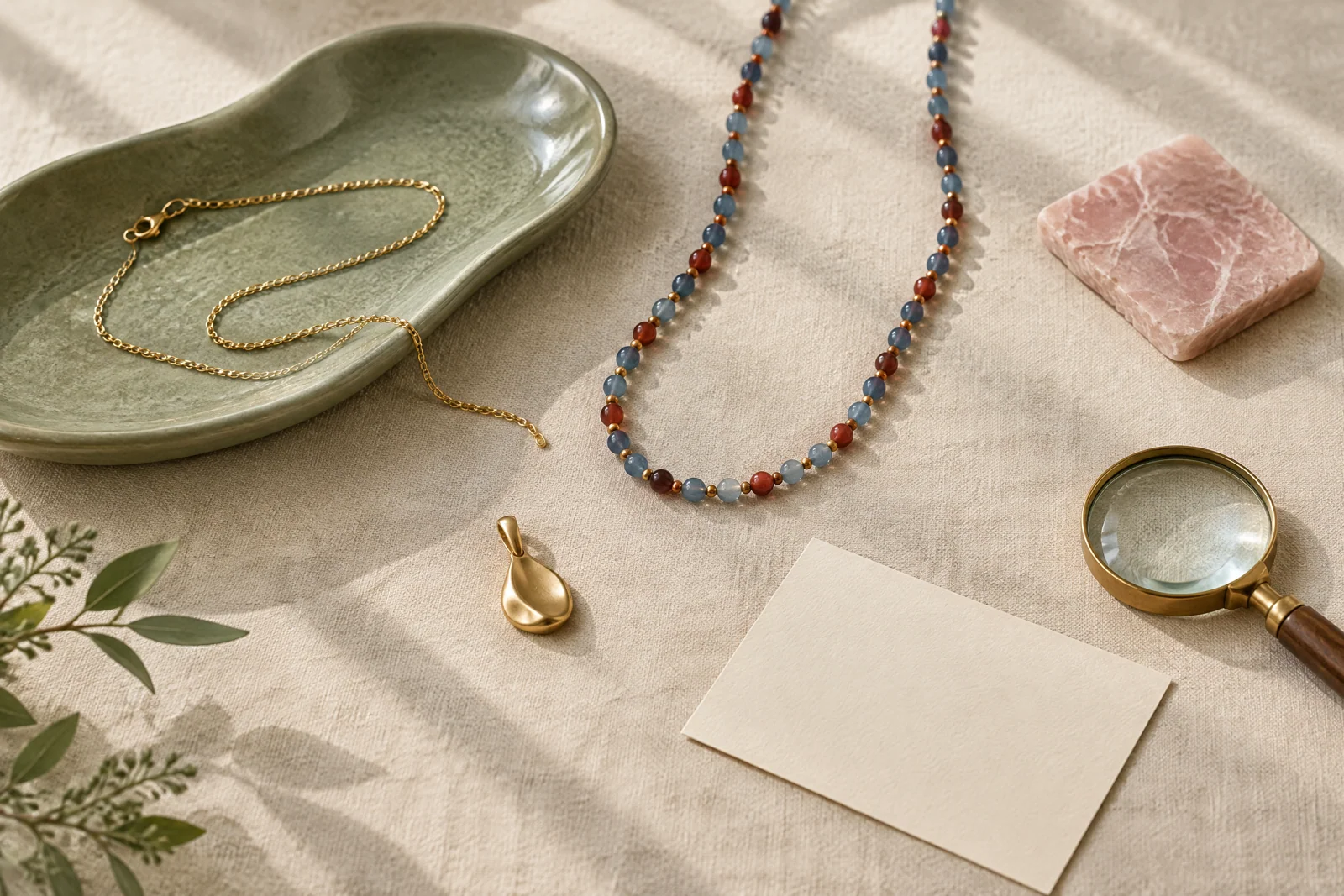
Color is one of the simplest tools in day-to-night jewelry: it can make an outfit feel more relaxed, lively, or evening-ready without changing its silhouette. A neutral work outfit—navy, charcoal, cream, denim, or black—offers a useful canvas for one saturated accent. Red brings warmth and a little energy; deep blue feels composed; sage softens a crisp look. Rather than matching every detail, repeat the accent once in a scarf, lipstick, bag, or shoe if that feels natural. A single color note is usually enough to make the shift noticeable. That restraint is part of what makes day-to-night jewelry feel polished instead of overworked.
Bead size and finish affect how a color reads. Small, regular beads can feel quiet and graphic, while larger or more irregular forms draw attention even in a restrained shade. Consider the lighting you will move through, too: a color that looks subtle at a desk may appear richer under warm restaurant lights. In day-to-night jewelry, the most versatile accent is not necessarily the brightest one; it is the shade that works with several pieces already in your wardrobe.
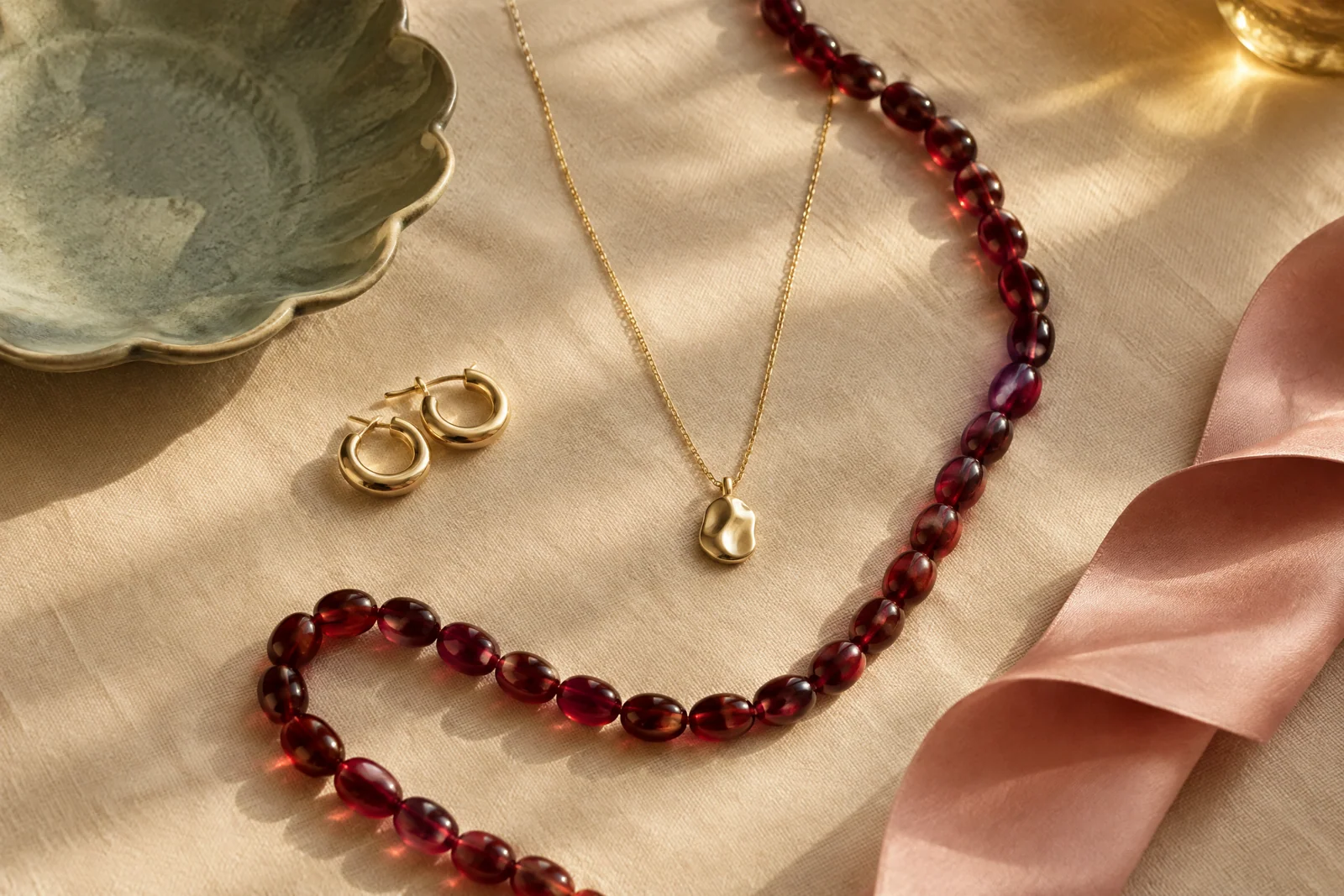
The catalog describes Karia as a rich red glass-beaded necklace with silver-plated mixed-metal details, approximately 42 cm long, with 10 mm beads. That combination offers a useful styling example: red supplies the color, while the necklace's length places it near the collarbone on many outfits. Try it against a cream blouse, a navy knit, or a simple black top, then keep other accessories quieter so the beads remain the point of interest. For other proportions and colors, explore necklaces and notice how each length meets your favorite necklines.
A color accent also helps when your evening plan is casual. It can make a familiar shirt and trousers feel considered without making them formal. If the outfit already has a strong print, borrow one color from the print rather than introducing another. This gives day-to-night jewelry a natural connection to the clothes, instead of making the accessory look like an afterthought. When deciding between two accents, choose the one that makes the whole outfit feel more intentional.
3. Use a two-piece swap for a noticeable, low-effort shift
Some day-to-night jewelry combinations call for a little more than one focal point, but a full change still feels excessive. Build a small two-piece swap: change your earrings and add a necklace, or replace a simple bracelet with a more expressive one while adding a ring. Keep one element familiar so the new combination feels connected to the daytime look. A matched color family or similar metal tone can do that linking work, even when the shapes are different.
For example, keep a fine chain on and add a bead strand, or trade small studs for hoops while leaving your necklace untouched. If you are wearing a patterned blouse, make one of the two additions simple; if your clothes are solid and spare, both can carry more character. This balance lets day-to-night jewelry feel like a considered edit rather than an entirely separate costume. Think of the change as a small adjustment in emphasis, not a new identity for the evening.
Think about proportion from a few feet away, not only close to the mirror. If both pieces are large, their visual weight can crowd the face and neckline. Pair a noticeable earring with a slim chain, or a distinctive necklace with a compact earring. With a high collar, shift the emphasis upward; with an open neckline, a pendant or beads can be the main event. Comfort matters just as much as the photo: check that closures are secure and nothing catches on hair, a scarf, or a jacket.
Keep your spare pieces together in a soft pouch and choose a place to change where you can set them down safely. If the day runs late, a planned two-piece swap should take only a minute. Avoid packing delicate or mixed-material pieces loose alongside hard objects. The goal is to make day-to-night jewelry easy to reach and easy to wear, not to create another task at the end of a busy day. A prepared pouch turns the transition into a simple ritual.
4. Make the formula yours: five quick combinations
Use these day-to-night jewelry ideas as building blocks, then choose the version that fits your plans, clothes, and personal comfort. These combinations are prompts, not rules; adjust the color and scale to what you already enjoy wearing.
- The quiet upgrade: Keep your daytime chain and add one sculptural or brighter earring. This works well with a crisp shirt, a knit, or a simple dress.
- The color note: Add a single vivid necklace to a neutral outfit and let it stand alone. Keep the neckline clear enough for the beads or pendant to show.
- The collarbone focus: Swap small earrings for medium hoops and wear a short necklace with an open collar. If both are detailed, choose one to be the lead.
- The soft shine: Leave your daytime earrings on and add a slim bracelet or ring that catches light as you move. It is a subtle choice for a relaxed dinner.
- The reset: Remove one daytime layer, then replace it with a single piece in a different color or finish. Editing down can feel just as fresh as adding more.
Before leaving in the morning, decide which formula could suit your plans and pack only what it needs. A tiny note on your phone—"hoops and red beads" or "keep chain, change studs"—can remove the 5 p.m. guesswork. Check that the day outfit and planned evening pieces work together in daylight, especially if you are mixing warm and cool colors. There is no requirement to match metals perfectly; repeat a tone once or let one metal be the intentional contrast.
Finally, let your actual evening set the level of polish. A neighborhood dinner may call for a colorful accent rather than a dramatic stack; a celebratory event may be the moment to wear the larger earrings you save for special plans. The strongest day-to-night jewelry approach is flexible enough to move with your schedule, and personal enough that you still feel like yourself. Ultimately, day-to-night jewelry is less about adding more than about choosing the detail that suits the next part of your day. If you would like to learn more about the independent boutique behind this edit, visit Duddingtons.
For day-to-night jewelry, comfort is the test that matters most: keep the pieces you can happily wear through both settings.
Related reading
For more ideas on styling around place, color, and confident choices, read A Jewelry-Inspired Weekend Style Guide to St. Augustine, Discover Duddingtons: Color, Character, and Everyday Jewelry, and How to Shop a Jewelry Collection Online with Confidence.