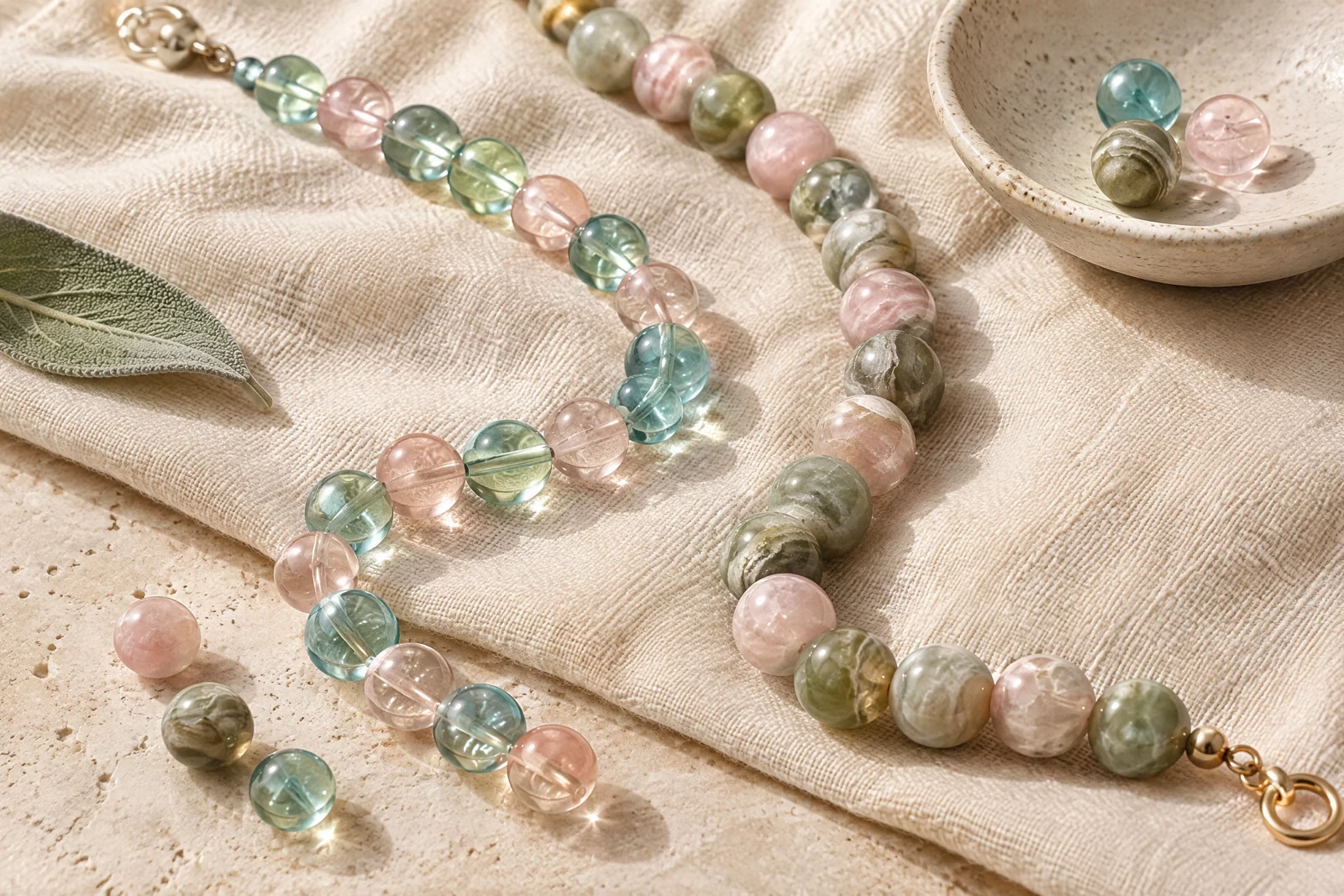
Glass beads and gemstone beads can look strikingly similar in a photograph, especially when both are polished into smooth rounds and shown in a soft, flattering light. In person, their differences become part of the pleasure: one may have clear, even color and a bright surface, while the other may reveal cloudy bands, mineral-like variation, or a more substantial feel. Neither material is automatically the better choice. The right one depends on the color story, mood, and wear you want from a piece.
This guide explains how to compare glass beads with gemstone beads without relying on guesswork or dramatic claims. For glass beads, look beyond the first flash of color. We’ll look at how each material handles color and light, what you might notice when you hold a strand, how to choose a necklace for your wardrobe, and how to care for beads when their exact construction matters. The goal is simple: help you read a product description with a more practiced eye and choose the piece that feels right for your everyday style.
Color and light: crisp clarity or natural variation?
Glass is made to a recipe, so its color can be remarkably consistent from bead to bead. Glass beads often make that consistency easy to see across a strand. Depending on how it is formed and finished, a glass bead may appear transparent, translucent, or opaque. A clear or translucent bead often catches a clean highlight and lets light travel into its body; an opaque glass bead can deliver a saturated, even color with a polished gleam. Glass beads can therefore look vivid without relying on a complicated pattern. Glass also makes it possible to create a broad range of hues, including colors that look especially bright, cool, or deliberately uniform.
Gemstone beads begin with mineral material, and their appeal often includes the small differences that come with it. Unlike glass beads, their visual character may include natural shifts within the same strand. A strand may show soft bands, cloudy inclusions, shifts in tone, or a mix of lighter and darker areas. Some stones are quite even; others are prized for visible pattern. The word “gemstone” covers many materials, so there is no single gemstone look or one reliable appearance that applies to every stone. A product description naming the specific stone is more useful than a general label alone.
When comparing photographs, notice the pattern across several beads rather than judging one close-up. Repeated, nearly identical color can be a clue to a consistent manufactured material, but it is not proof by itself. Natural-looking variation can suggest stone, yet glass can also be artfully swirled, layered, or finished to create variation. Some glass beads are intentionally patterned, so a varied look alone does not identify a stone. Lighting, image editing, surface coatings, and the size of a bead all change what you see. Treat appearance as a helpful observation, not a definitive material test.
For a clear, coordinated color accent, glass beads may suit a wardrobe built around one deliberate shade. Glass beads in a familiar color can be an easy way to repeat a favorite accent. For a quieter, more organic effect, the varied surface of gemstone beads can add pattern without introducing a new motif. Consider the colors already in your closet: aqua glass can echo a cool blue shirt, while a softly banded sage stone can sit comfortably beside cream, denim, or muted green. Explore the broader necklace collection with your own palette in mind rather than searching for a material as a status marker.
Touch, weight, and the way a strand wears
In a finished necklace, bead size, shape, spacing, and stringing can affect comfort as much as the bead material. Small beads on a fine strand may feel light and flexible; larger rounds can feel more noticeable against the collarbone. Gemstone beads are often denser than glass of a similar size, but bead dimensions, drilling, strand length, and metal findings all influence the overall weight. Glass beads also vary in size, so compare measurements rather than material names alone. If a listing gives measurements, use them to picture scale. If it does not, ask the shop for clarification rather than assuming a particular feel.
Glass can feel smooth and cool, with a glossy surface that reflects a sharper point of light. Glass beads with a clear finish may emphasize that bright, clean reflection. A polished gemstone can also feel smooth, yet its pattern and subtle surface differences may make it seem more tactile or visually grounded. These are broad impressions, not rules: finishes vary, and the distinction is not always obvious by touch. For a worn piece, the full design matters. A neat, even strand reads differently from larger, irregularly shaped beads, whether those beads are glass or stone.
Catalog examples make the distinction more concrete. The glass beads in Midnight give a useful example of a polished, ink-blue color story. Duddingtons’ Midnight necklace is described as ink-blue glass beads with a shell-like charm and gold-plated mixed-metal details; its stated overall length is about 40 cm, plus a 5 cm extender. By contrast, Ice Bubble is described as a fresh-blue round-bead necklace made with gemstone beads and silver-plated mixed-metal details, at about 43 cm. The blue color family connects the two, while the material and metal descriptions give each a different visual direction. These details describe the listings, not a promise that every bead will look identical or feel the same on every wearer.
Compare a necklace’s stated length with a chain you own; a few centimeters change where beads sit. A strand of glass beads can feel visually bold even when its measurements seem modest. Browse the new arrivals for layering ideas, checking each listing’s dimensions.
Choosing between glass and gemstone beads for your style
Start with the job you want the necklace to do. If it is meant to bring a clear pop of color to a neutral outfit, glass beads offer a direct, polished note. Glass beads can keep that color note cohesive from one end of a strand to the other. A strand in a single vivid hue can make a simple knit or white shirt feel considered without adding a complicated pattern. If you want color that feels softer or more layered, gemstone beads can introduce tonal shifts that echo other shades in an outfit. Either can be a focal point; neither needs to be reserved for special occasions.
Then consider the rest of your jewelry. Glass beads can balance a simple metal pendant or stand on their own as the outfit’s color focal point. Glass with a bright finish can pair neatly with clean metal shapes or a crisp color-blocked outfit. Gemstone beads with visible variation can complement woven textures, linen, softly printed fabric, or a second strand in a quieter tone. This is styling guidance, not a rulebook: contrast can be more interesting than matching. A blue bead necklace against warm blush clothing, for example, can feel fresh precisely because the colors are not identical.
Before buying, read the full material description, not just the product name or color. Look for the stated bead material, the metal used for the clasp and findings, the strand length, and any information about finish. Bead material and metal components are separate parts of a piece. “Gold-plated” refers to a surface layer over another metal, while a gemstone bead describes a different component; one label should not be taken to describe the whole necklace. If the description says only “beads,” ask whether the shop can identify the material. Clear answers are more useful than trying to infer a precise composition from a styled image.
For an easy decision, use a three-question check. Ask whether glass beads or gemstone beads better suit the color and scale you have in mind:
- What color effect do I want? Even and luminous, softly banded, or a particular balance of both?
- What scale feels wearable? Check stated bead dimensions and necklace length against pieces you know.
- What information is confirmed? Separate the bead material from metal findings and ask about any unspecified component.
Use that check as a guide, not a test you must pass. If you are choosing a gift and do not know the recipient’s preferred material, lean on colors and proportions you have seen them wear, and choose a design whose details are clearly described. You can also browse beaded necklaces and compare the listed materials side by side. A useful product page should help you understand what is being presented; it should not need a grand promise about what a material can do.
Gentle care for both materials
Good care begins with the least aggressive option. To protect glass beads, avoid letting a strand knock against hard surfaces or heavier accessories. After wearing a beaded necklace, use a soft, dry cloth to lift away surface residue, then store it separately so the beads do not rub against harder jewelry. Keep strands from twisting or carrying unnecessary tension, and fasten the clasp before putting a necklace away. A simple pouch or divided compartment can help limit scratches and tangles. These habits are useful whether a strand contains glass, gemstone, or a combination of materials.
Avoid assuming that every beaded piece can be soaked, sprayed, or cleaned the same way. A necklace may combine beads with a plated clasp, mixed-metal findings, cord, thread, adhesive, or a finish that needs gentler treatment. Water and household cleaners can affect components differently, and a stringing material may be more vulnerable than the beads themselves. Unless a seller provides care instructions for that exact piece, skip prolonged soaking, harsh chemicals, abrasive cloths, and ultrasonic cleaning. If there is stubborn residue or a loose component, ask the retailer or a qualified jeweler before trying a more intensive method.
Glass is not immune to damage: a hard impact can chip or crack it, and surface scratches can dull a glossy finish. Gemstone beads also differ from one another in hardness, cleavage, porosity, and treatment, so broad advice cannot safely cover every stone. Avoid tossing a strand into a bag with keys or metal accessories, and take it off before activities where it could be knocked or pulled. Do not use a bead’s apparent toughness as a reason to test it against a hard surface.
Storage and inspection make care practical. Once in a while, look over the clasp, extender, and visible stringing for wear; stop wearing the necklace if a strand looks compromised, and seek repair advice rather than waiting for it to break. Store beads out of direct, prolonged sun and away from perfume, hairspray, and lotions when possible. Put jewelry on after applying personal-care products and remove it before bathing or swimming, especially when the necklace includes metal or stringing you cannot identify. For mixed-material pieces, follow the most delicate component’s needs.
In the end, glass beads and gemstone beads are best understood through their particular combination of color, surface, scale, and construction. Choosing glass beads is one way to prioritize a clear, coordinated color effect; choosing gemstone beads can foreground natural-looking variation. Glass can offer clarity and a confident, consistent hue; gemstone beads can bring mineral patterns and natural variation. Careful reading helps you distinguish what is known from what is only suggested by a photograph, while gentle handling keeps the whole necklace in mind—not just the beads. Choose the material whose look you will enjoy reaching for, then let thoughtful care protect that enjoyment.
Related reading
For more material guidance, continue with Gold-Plated vs Gold-Filled Jewelry: A Clear Comparison, Freshwater Pearls vs Faux Pearls: What to Know, and What Is Gold-Plated Stainless Steel Jewelry?.