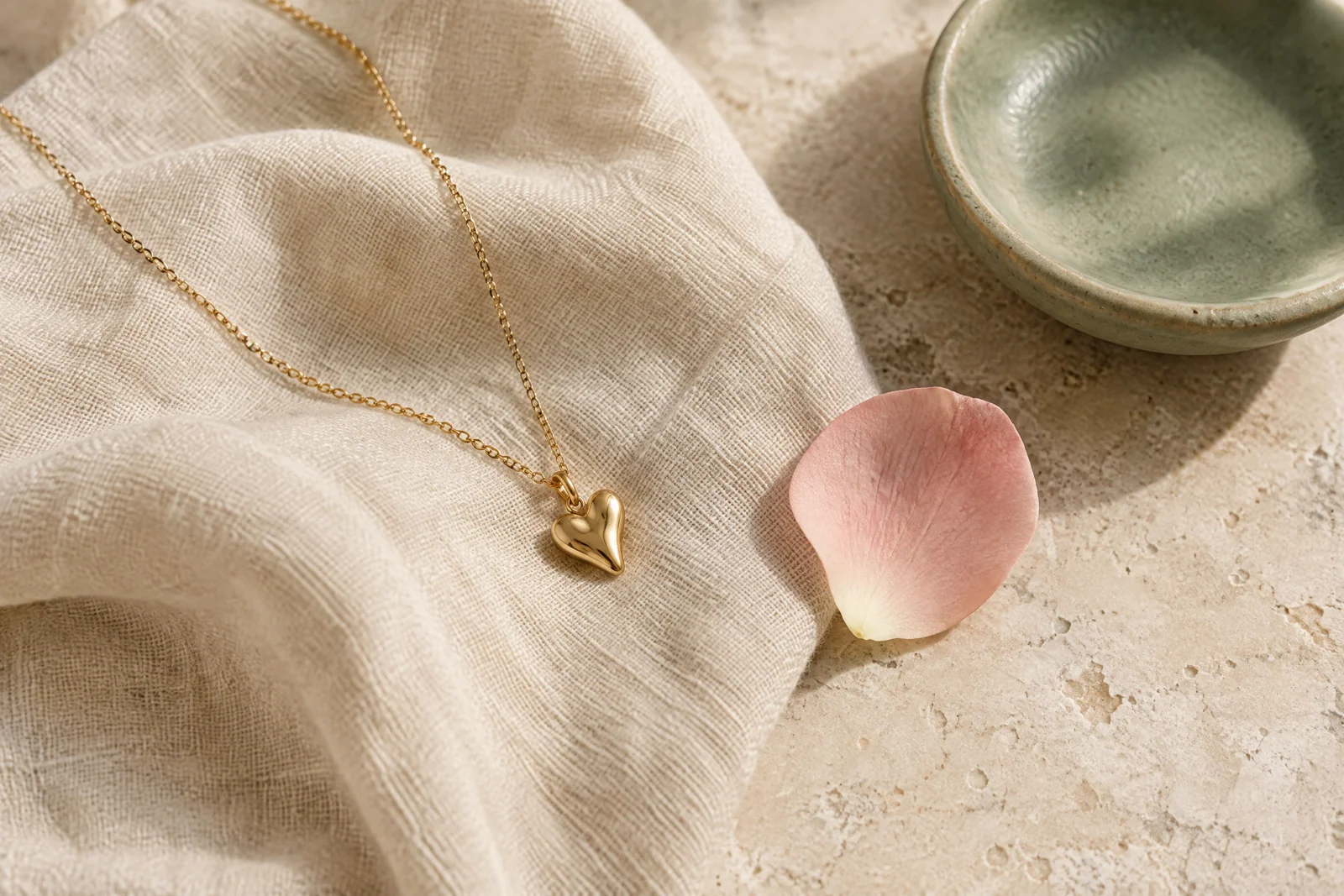
A heart is a familiar shape, but it need not belong to one date on the calendar. Heart jewelry can feel quietly personal with a crisp shirt, a favorite knit, or a simple summer dress when its scale, finish, and color suit the way you dress. The secret is less about making a declaration and more about choosing a version that feels like you: a tiny outline, a smooth sculptural charm, or a bright enamel accent. Think of the motif as a small point of punctuation, and it becomes easy to wear well beyond Valentine’s Day.
At Duddingtons, we like jewelry that brings a little character to everyday outfits without asking you to save it for a special occasion. Use the ideas below as a practical edit: start with silhouette, build a color relationship, then make the piece work with your neckline and routine. Whether you already own a heart or are considering one, a few thoughtful choices can make the shape feel personal rather than seasonal.
Choose a heart shape that feels like your style
Heart jewelry spans a wider visual range than the classic small red charm suggests. A fine outline reads airy and understated; a rounded, puffy form feels playful and sculptural; a flat or softly irregular heart can look more casual and collected. The same motif changes character with its proportions, surface, and setting, so choose by the impression you want rather than by the symbol alone. Heart jewelry feels most natural when that impression fits the rest of your wardrobe.
For a first piece, consider the scale you naturally reach for. A petite pendant makes a subtle focal point and can sit comfortably beside other everyday pieces. A larger charm has more presence, so it often works best as the one clear feature near the face. If you love a bolder look, balance the heart’s width with the scale of your chain or earring: an ample pendant on an extremely fine chain may twist or visually disappear, while a substantial chain can give a small charm a deliberate frame. That balance helps heart jewelry look considered beside its chain.
Finish matters just as much. High shine catches light and gives a rounded shape a polished, graphic quality; a colored enamel surface introduces a more spirited note; mother-of-pearl brings a softer, shifting glow. These are different visual moods rather than a hierarchy. If your wardrobe is mostly denim, cotton, and knits, an easygoing finish may feel natural. For tailored clothes, a clean outline or smooth metal can keep the motif crisp. The right finish lets heart jewelry echo a fabric’s texture without matching its color.
It can help to compare the heart with pieces you already wear. Lay it beside your favorite chain or studs and notice whether the shapes compete or complement each other. On Duddingtons, Heart Of Pearl pairs a 30 mm mother-of-pearl heart with a chunky chain and gold precious-metal rings; it is a more substantial, framed take on the motif. By contrast, Red Hot Heart uses a 30 mm hollow puffy heart with enamel on a textured chain for a brighter point of color. Those details are useful style cues, not rules about what every heart should look like. They show how heart jewelry can feel expressive without needing an oversized silhouette.
Style heart jewelry with color and contrast
Color is the easiest way to make heart jewelry feel like part of an outfit instead of a holiday reference. Start with the colors already in your closet. Gold-toned metal sits warmly against cream, camel, olive, and many shades of denim. Silver-toned pieces can feel cool and clear beside black, gray, crisp white, or blue. These are starting points, not strict matching rules: repeating one small color elsewhere in a look can make a contrast feel intentional. One repeated accent helps heart jewelry join a color story rather than read as a holiday cue.
A red or pink heart can be the outfit’s only saturated accent. With a white shirt and dark jeans, it brings focus without needing a second bright accessory. With a blush blouse, try choosing a heart whose red is deeper or more vivid than the fabric, so the shapes do not blend into one wash. If you prefer a quieter palette, mother-of-pearl, cream, or pale enamel can keep the heart motif visible through texture and reflection rather than strong color. Muted surfaces let heart jewelry read as shape first and color second.
Try a deliberate contrast in scale and surface. A smooth, glossy heart looks lively against matte linen or a soft knit; a delicate chain can soften a structured blazer; a colored charm can lift a neutral tee. If the pendant already has a bold shape, keep nearby accessories simple. If the heart is tiny, you have more room to add a fine chain or small hoops without turning the look into a cluster. This is an easy route to heart jewelry that feels polished but not over-planned.
Layering works best when each piece has a clear job. Let the heart sit at the front as the focal point, then add one fine chain at a noticeably different length rather than one nearly identical to its chain. A longer second necklace can create separation, while a plain chain avoids a second pendant competing for attention. Check that clasps and chains do not snag on each other, and adjust the lengths so the pendants do not land on the same spot. For more combinations, browse our necklace collection and experiment with a simple base chain. A clear difference in length gives heart jewelry room to remain the visual anchor.
Make the motif work with necklines and everyday plans
The neckline determines where a pendant lands and how much of it remains visible. A heart that sits just above a crew neck may disappear against the fabric; a slightly longer chain can put it in view. Open collars create a natural frame, especially when the pendant falls into the V without reaching the shirt opening. With a high-neck top, a longer chain can stand out against the fabric, while a larger charm may be the stronger choice over a plain sweater. Small adjustments let heart jewelry respond to the neckline instead of fighting it.
Think about movement as well as the mirror view. If you are wearing a scarf, a collared shirt, or a textured knit, a low-profile charm is less likely to catch on layers. For a simple dress or open-neck blouse, a more sculptural shape can carry the look on its own. Heart jewelry does not have to be delicate to feel versatile; the useful question is whether the chain length and charm size suit the clothes you plan to wear. That check makes heart jewelry more practical for real days than a mirror-only styling test.
Earrings can echo a necklace without repeating the same shape everywhere. A small heart pendant with plain hoops feels relaxed; heart earrings can take the lead with an unadorned neckline and no necklace. If you choose matching motifs, vary the scale or finish so the result looks considered rather than like a costume set. You can explore the earrings collection for simple shapes that sit comfortably alongside a pendant.
For everyday wear, consider how you move through the day: will the necklace sit under a jacket, rest over a T-shirt, or be layered with a lanyard or scarf? Put it on after dressing when possible, and take care around zippers and fine knits. If a piece feels fussy or catches repeatedly, save that pairing for a calmer outfit and choose a simpler chain on busy days. Practical styling is not about limiting a favorite; it is about finding the setting where it can be enjoyed.
Choose thoughtfully, care gently, and wear it your way
A heart makes a meaningful gift because the shape can suggest affection, friendship, remembrance, or simply a fondness for playful design. Let the recipient’s usual style guide the choice. Someone who wears minimal jewelry may prefer a smaller charm or quiet finish; a color lover might enjoy enamel; a person who likes statement accessories could appreciate a larger sculptural heart. When you are unsure, notice whether they tend toward gold or silver tones, short or long chains, and polished or textured surfaces. Choosing heart jewelry around those familiar habits can make a gift feel especially personal.
Look at the full material description before choosing. “Gold-plated,” “gold-fill,” and “solid gold” describe different constructions and should not be treated as interchangeable. A listing may also include enamel, mother-of-pearl, glass, or another material that needs its own care. For example, the catalog description for Heart Of Pearl identifies gold-plated mixed metal, mother-of-pearl, and 14k gold-fill details; Red Hot Heart is described as gold-plated mixed metal with enamel and 14k gold-fill details. These descriptions help you understand what is in each design, but they are not a promise that every component will respond to wear or cleaning in the same way. For mixed materials, heart jewelry deserves the care approach of its most delicate component.
For a gentle routine, keep jewelry away from unnecessary moisture, cosmetics, and household cleaners, and follow any care information supplied with the particular piece. After wearing, wipe it lightly with a soft, dry cloth if appropriate for its materials, then store it separately so chains do not tangle and surfaces do not rub together. Avoid soaking a mixed-material piece or using an ultrasonic cleaner unless care guidance for that exact item says it is suitable. Gentle, specific habits help heart jewelry keep its character over time. If you are uncertain about a finish or stone-like component, ask before cleaning rather than testing a strong product on it.
Ultimately, heart jewelry is most convincing when it belongs to your own rhythm. Wear one heart as a quiet keepsake, let a brighter one punctuate a neutral outfit, or bring it out with a favorite open collar. There is no need to reserve the shape for a particular season or to build an entire look around it. Choose a scale you enjoy, give it breathing room, and let color or texture connect it to the rest of what you wear. That is how a familiar symbol becomes an everyday signature rather than a once-a-year accessory.
Related reading
Keep exploring our style notes: Coastal Jewelry: Bringing a Little Seaside into Your Style, Shell Jewelry: Natural Variation and Styling Ideas, and Fish Necklaces: A Playful Motif with Everyday Appeal.