A necklace can be beautiful in the mirror and still feel wrong by lunchtime. The cord is often the difference: it changes the way a pendant moves, how a necklace rests against skin, and whether the piece feels easy enough to reach for again tomorrow. The best cord necklaces are not simply casual alternatives to chains; their material, thickness, length, and finish all shape the wearing experience.
This guide compares cotton and leather cords, explains what to check before choosing a pendant necklace, and offers practical fit and care advice for everyday use. “Cord” is a broad description rather than a guarantee of a particular fiber, so read the individual product details instead of assuming every cord is cotton, leather, or adjustable. A little attention to those details helps you choose cord necklaces that suit your clothes, routine, and preferred feel. Cord necklaces feel most considered when the cord, pendant, and outfit work together.
Start with the material and how it feels
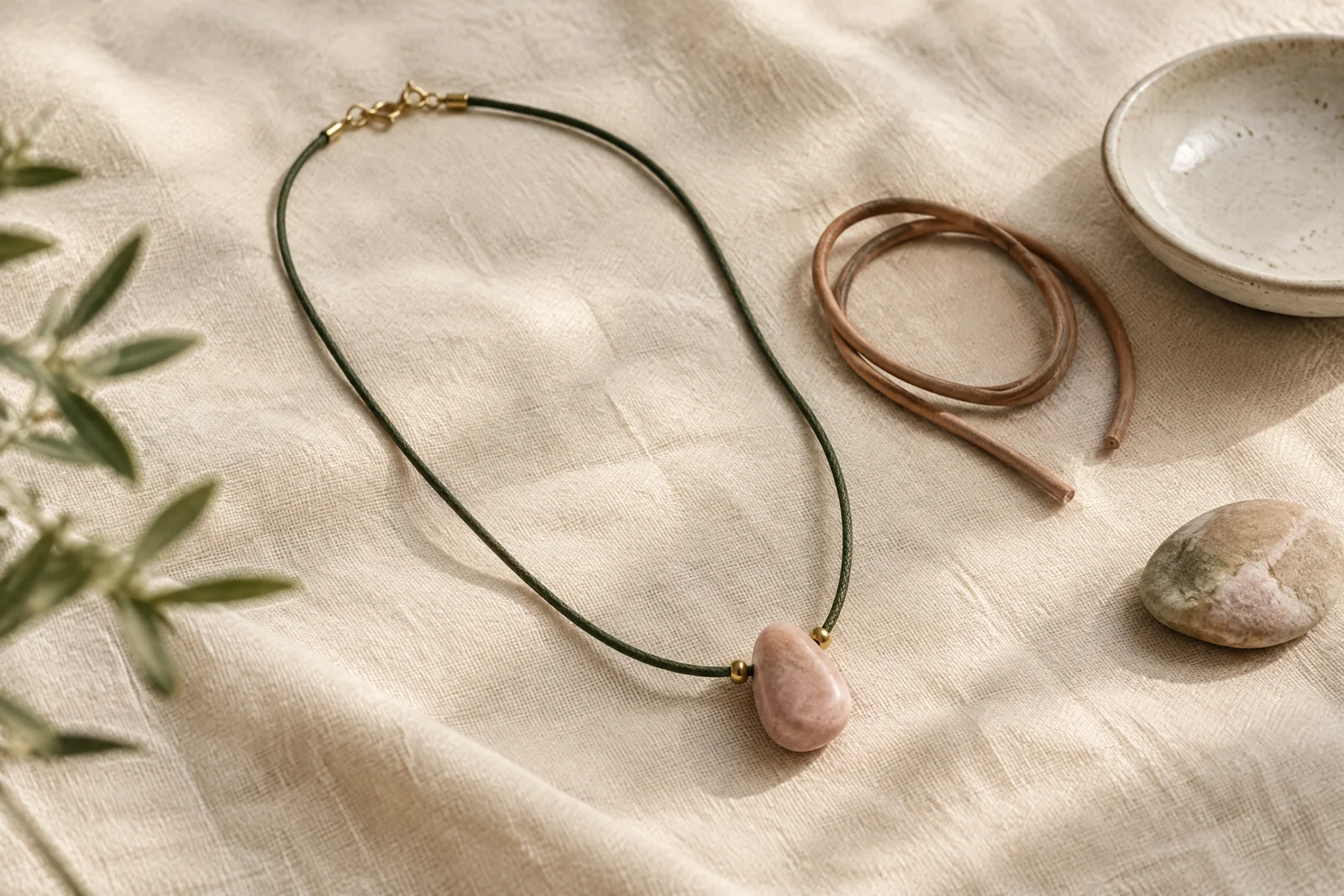
Cotton and leather create distinct impressions, but neither is automatically more comfortable for everyone. Cotton cord generally reads relaxed and textile-like; leather tends to look smoother and more defined. The actual experience depends on the cord’s construction, diameter, finish, pendant weight, and how the necklace sits on you. If possible, notice whether the cord feels soft or firm, whether it bends easily, and whether the ends or knots have a finish that might rub or catch. For cord necklaces, softness and flexibility matter as much as appearance.
Product descriptions can be more specific than a broad category label. For example, Duddingtons’ Etta is described as a large green agate bead on green leather cord, with an 80 cm cord and a 50 mm donut bead. The listing for Starfish On A String describes a beige leather cord measuring one metre, intended to wrap as a choker or wear long. Those are useful construction and length details, not a universal promise about how every leather cord will feel or fit. Clear descriptions make cord necklaces easier to compare.
Cord can be woven, twisted, waxed, or combined with metal findings and a pendant. The Etta listing uses conflicting cord wording—green leather in one sentence and waxed cotton in another—so verify the material with the retailer if it matters to your choice. Treat “cord” alone as a general description, not a fiber specification.
Before choosing, consider the way the pendant meets the cord. A small, light charm may sit comfortably on a fine cord, while a heavier or broad pendant can pull the center downward, twist the necklace, or make a narrow cord feel less balanced. A wider cord can give a bold pendant visual proportion, but the combination may feel more substantial at the neck. Comfort is personal; the useful question is whether the complete necklace—not the cord in isolation—feels settled when you turn, sit, and move. Cord necklaces with a larger pendant may feel more substantial at the neck.
For more material-led options and comparisons, browse the necklace collection and check each item’s composition and measurements. A product name or photograph can suggest a look, but the written description is where you confirm the stated material, length, pendant size, and closure details.
Choose a length and closure that work in real life
Length affects both appearance and comfort. A short cord can frame the base of the neck; a longer one gives a pendant room to move and may work over a shirt or dress. There is no single ideal length for every neckline or body. Compare the stated measurement with a necklace you already enjoy, or use a soft measuring tape to see where the cord would fall. Remember to check whether the listed measurement is the cord itself, the full necklace, or the wearable length after a clasp or extender is included. A familiar reference length helps compare cord necklaces before ordering.
Adjustability matters when you want more than one styling position. A sliding knot can offer flexible placement, while a fixed loop, tied ends, or metal clasp creates a more defined length. Do not assume a cord is adjustable just because it appears to tie; confirm the product description. For example, the catalog entry for Lucky Fish describes a red cord necklace with a small extender chain and a 27 mm fish pendant, but identifies the cord composition simply as cord. Its listed overall length is 42 cm plus a 5 cm extender. That is a useful example of how a cord necklace may pair a textile element with metal components. For cord necklaces, confirm adjustability rather than assuming it.
Think about when and how you will wear the piece. If you plan to layer, leave a visible gap between necklace lengths so the cords and pendants do not crowd one another. A cord with a substantial pendant often works best as the focal point, paired with a finer chain that sits clearly above or below it. If you prefer a simple daily uniform, a length that sits neatly at the neckline of your usual tops may be more useful than a dramatic length you need to adjust around every outfit. Explore necklaces by style with the garment you wear most often in mind. Cord necklaces can layer well when lengths are visibly distinct.
Pay attention to the back of the necklace, too. A clasp, extender, knot, or sliding adjuster can affect the way the piece rests and whether it catches in hair or clothing. Consider where the closure will sit, how easy it is for you to fasten, and whether the cord ends are finished cleanly. If a pendant has a narrow opening, confirm that the cord can pass through it without scraping or binding. Small construction details can matter more to everyday comfort than a decorative feature visible from the front. These details are especially useful when comparing cord necklaces online.
Check measurements against a necklace you own or use a piece of string to estimate the drop. Photographs help show shape, but not reliable scale; ask the retailer if a measurement or its starting point is unclear.
Style cord necklaces with color, texture, and proportion
Cord necklaces add texture to a fine metal chain. Contrast a smooth cord with a soft knit, or a woven one with linen or denim; let the neckline and pendant guide the choice.
A dark cord can echo a belt or print detail. Green cord necklaces feel tonal with a green stone, while tan or beige brings warmth to white; a red cord adds a clear accent against cream or denim.
A cord close to your skin tone or top color makes its pendant stand out; a contrasting cord emphasizes the necklace line. Repeat one accent elsewhere if you like, but exact matching is unnecessary.
Proportion matters: a fine cord can disappear under a thick sweater, while a large pendant may compete with a busy print. Try cord necklaces with the tops you wear most and adjust length if a pendant catches on a neckline.
Layering is possible, but give each piece room. Pair one cord necklace with a chain of a different length and texture, keeping the focal pendant unobstructed. Two cords of similar thickness and nearly identical length can bunch together, especially if both carry substantial pendants. For a more collected look, vary at least one quality—length, cord color, pendant scale, or metal tone—and check that the closures do not tangle at the back. You can find other shapes and materials in accessories and necklaces if you want to build a small rotation rather than force one piece to do every job.
For an easy day-to-evening shift, keep the cord necklace and change the surrounding styling: add a jacket, open a collar, or switch earrings. Scale, color, and finish can make the same pendant feel relaxed or more polished.
Care for cord and mixed materials with a light touch
Mixed-material cord necklaces may combine fiber, leather, stone, and plated metal. Put them on after fragrance or lotion, and remove them before bathing, swimming, exercise, or sleep. If damp, blot gently and air-dry away from heat; do not soak leather or stretch wet cotton.
As a cautious everyday habit, put a cord necklace on after applying fragrance, lotion, sunscreen, or hair products, and remove it before bathing, swimming, strenuous activity, or sleep. This helps limit unnecessary contact and pulling; it is not a guarantee against wear. If the cord gets damp, blot rather than wring it, and allow it to air-dry fully away from direct heat. Leather should not be soaked or aggressively scrubbed, and a cotton cord should not be stretched while wet. Avoid harsh household cleaners unless the maker specifically confirms they are appropriate for every part of the piece. Remove cord necklaces before activities that involve water or repeated pulling.
After wearing, check the cord near the pendant opening and closure for fraying, discoloration, loosened knots, or a change in shape. That quick look can catch a problem before a pendant slips free. For a dusty surface, use a clean, soft, dry cloth on the components it can safely reach. Do not rub a delicate finish or scrub a cord to remove a mark; consult the retailer if you are unsure how to treat a specific stain or material. Inspect cord necklaces near the pendant and closure for early signs of wear.
Store cord necklaces separately, without sharp bends or heavy pieces pressing on them. Fasten the clasp to reduce snags, and keep the piece dry and away from strong heat or direct sun.
If a cord becomes scratchy, stiff, or uneven, inspect it and pause wearing it until you understand the change. A loose knot or worn section may need attention; pulling tighter can worsen it. Keep a note of the fit and materials you enjoy for next time.
Ultimately, the most wearable cord necklaces are the ones whose construction suits your habits and whose proportions feel like you. Cotton and leather offer different visual and tactile directions, but the label alone cannot predict comfort. Read the material notes, check the measurements, consider the pendant as part of the whole, and give mixed materials gentle, specific care. Those small steps make it easier to choose a necklace you will enjoy reaching for often.
Related reading
For a closer look at neighboring materials, continue with Gold-Plated vs Gold-Filled Jewelry: A Clear Comparison, Glass Beads vs Gemstone Beads: Color, Feel, and Care, and Freshwater Pearls vs Faux Pearls: What to Know.