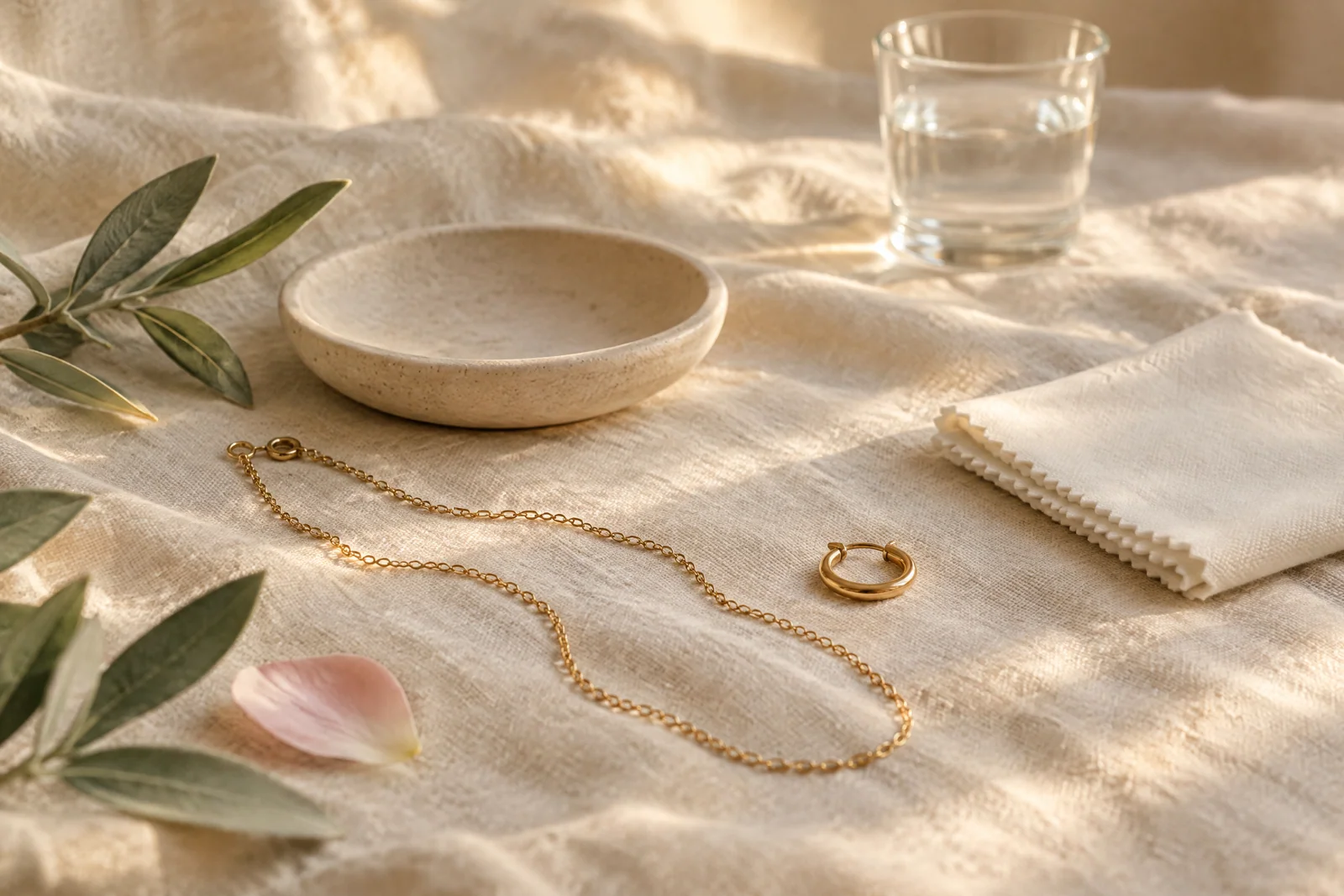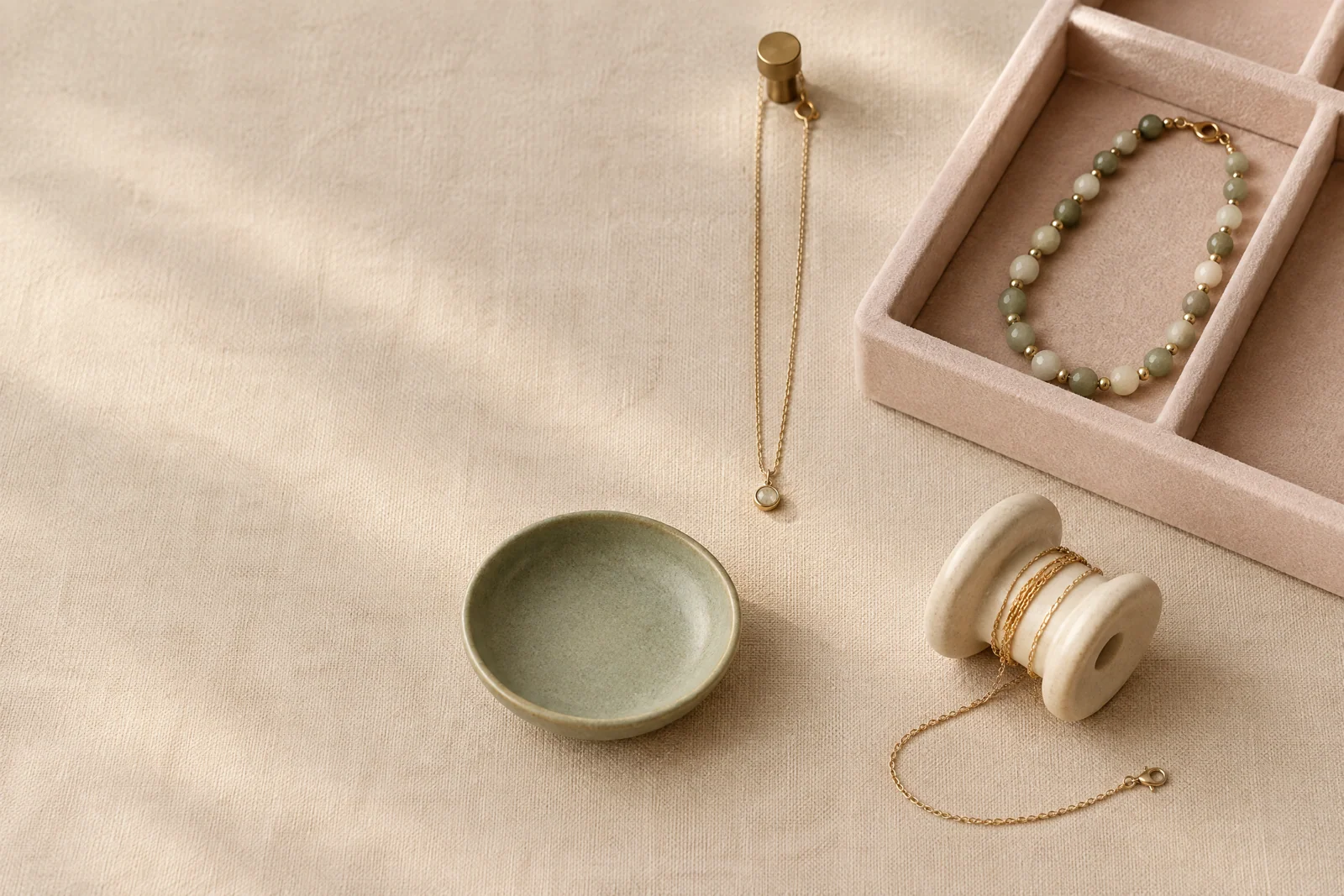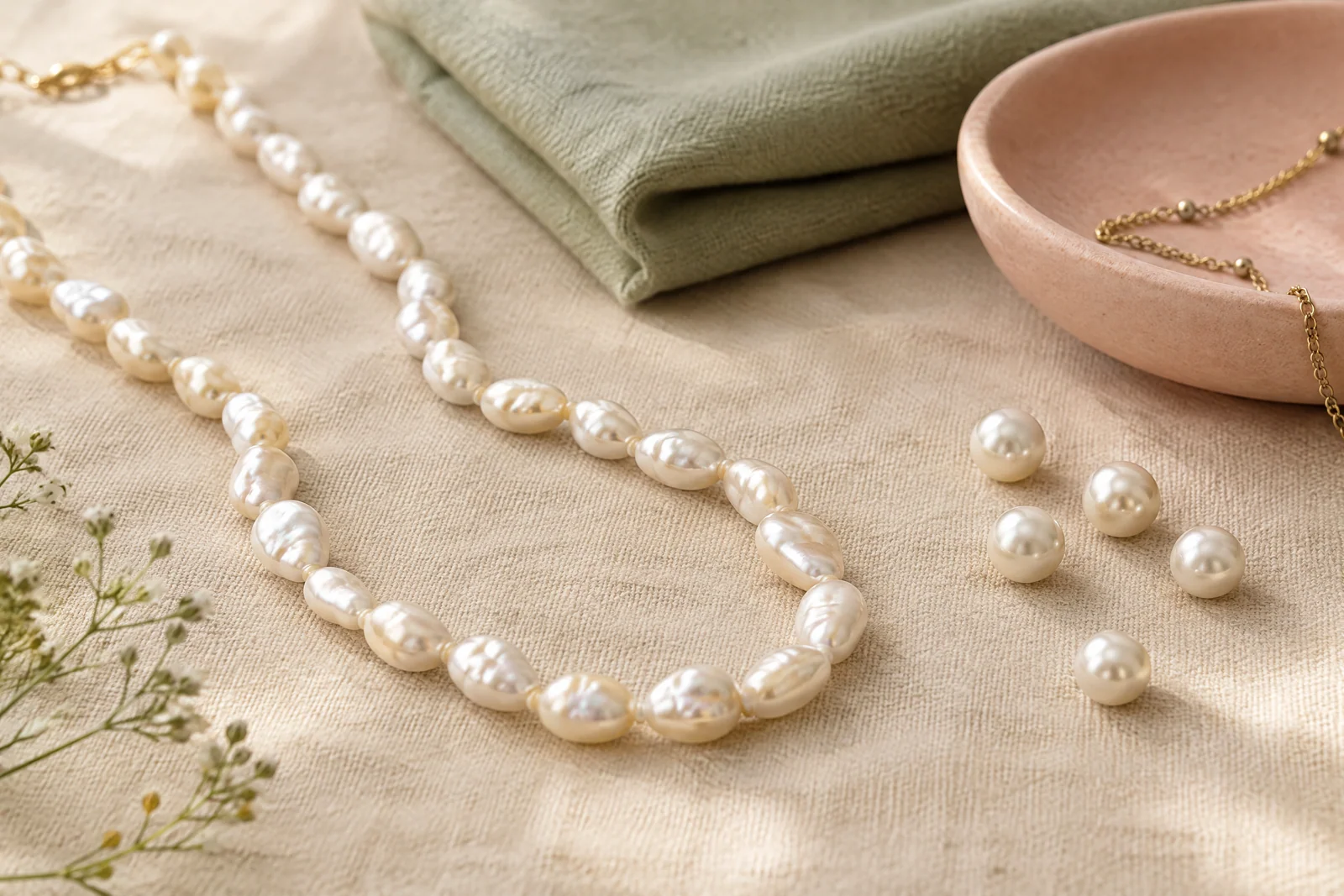
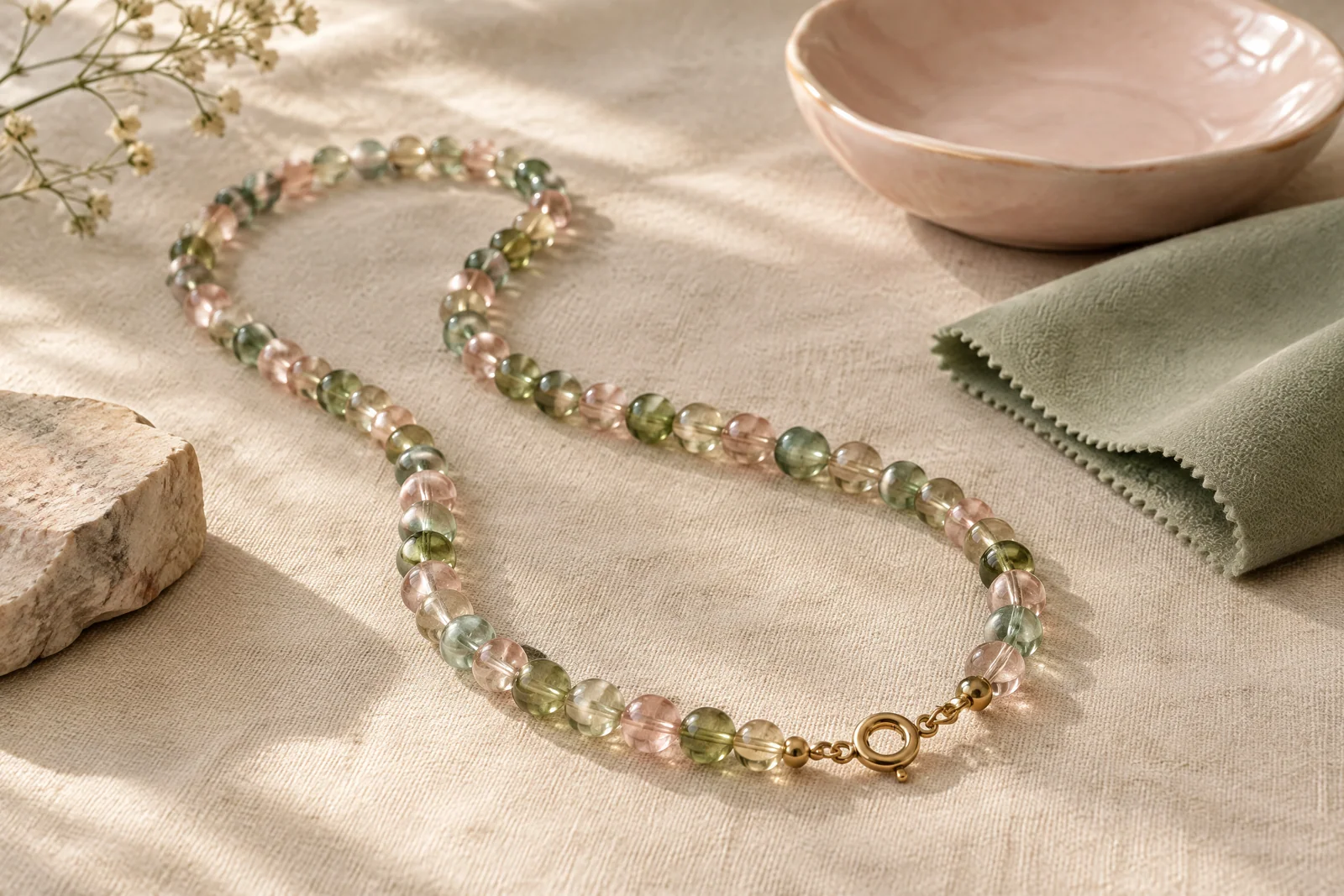
Beaded necklace care is less about a complicated cleaning ritual than about a few calm habits: notice what the strand is made of, keep it away from avoidable stress, and give its clasp a quick look before wearing. Beads may be glass, stone, shell, wood, resin, or another material, while the thread, wire, knots, and metal findings can each respond differently to moisture and friction. That variety is why beaded necklace care starts with a gentle, dry-first approach rather than one universal cleaning recipe. This dry-first instinct is a dependable foundation for beaded necklace care.
A necklace that is worn often gathers traces of skin oils, fragrance, lotion, and dust; its clasp also takes the strain of every fastening. Thoughtful beaded necklace care helps keep the colors clear and makes small changes easier to spot before a strand becomes difficult to wear. The useful routine is simple: check, wipe, let the piece air-dry if needed, and store it without pressure or tangles.
Start with the beads, stringing, and finish
Before cleaning, take a moment to identify what you can. Look at the product description or any care note that came with the necklace. If the details are unclear, treat the most delicate component as the guide. A strand with beads, a metal clasp, and a textile thread is not one uniform material; a method suitable for one element may be unsuitable for another. In practical beaded necklace care, restraint is more useful than guessing. When in doubt, the least intervention is often the wisest choice.
Glass beads are generally easy to wipe, but decorative coatings, painted surfaces, foil backs, or small applied details can be more sensitive than the glass itself. Natural stones vary in hardness, porosity, and surface treatment, so avoid assuming that every gemstone can be scrubbed or soaked. Shell, pearl, wood, leather, cord, and some resins also call for extra caution around water, heat, and strong cleaners. Even when beads seem sturdy, the thread or knots between them may be the vulnerable part. Remembering that is a useful beaded necklace care habit.
Metal findings deserve their own attention. A clasp may be plated, filled, solid, or a different alloy altogether; those terms are not interchangeable. If a description says gold-plated mixed metal, for example, care should focus on limiting abrasion and chemical exposure rather than treating it as solid gold. Do not use a polishing compound on a whole beaded strand: it can catch in the gaps, mark beads, or reach places that are hard to rinse completely.
Check the strand in good light before you begin. Notice whether the beads are glossy or matte, whether a color looks painted or naturally varied, and whether the stringing is visible. Gently flex the necklace only as it would move when worn; do not pull it taut to test it. This small inspection is part of thoughtful beaded necklace care. If a bead is already loose, a knot has shifted, or the clasp looks bent, pause routine cleaning and handle the piece carefully until it can be assessed.
When a jewelry description gives a particular construction, use that as a starting point, not as a promise that every component should be treated the same way. For instance, the Midnight beaded necklace is described as glass beads with a shell-like charm and gold-plated mixed-metal details. That combination is a good reminder that beaded necklace care must account for every component: clean gently and avoid immersing the whole necklace just because the beads are glass.
Use a gentle, dry-first cleaning routine
For ordinary dust or light surface marks, begin with a clean, soft, dry cloth. Hold the necklace loosely in one hand and wipe each section with the other, supporting the beads rather than dragging the cloth along the entire strand. Work around the clasp and any spacer beads without tugging. This is a simple, repeatable approach to everyday beaded necklace care. A soft artist’s brush can lift dry dust from crevices, but use it lightly and only if the surface is not fragile or flaking.
If a dry cloth is not enough, check the maker’s instructions before introducing moisture. Where the materials are known to tolerate it, slightly dampen a corner of a soft cloth with plain water, wring it well, and touch only the soiled area. Avoid wetting thread, knots, leather, cord, glued components, porous beads, and metal parts unless the specific care guidance says otherwise. Beaded necklace care should never default to soaking a mixed-material piece in a bowl; a controlled spot wipe is a more cautious option when the materials allow it.
After any careful spot wipe, use a second dry cloth to remove surface moisture, then lay the necklace flat on a clean towel until fully dry. Keep it away from direct sun, heaters, hair dryers, and other strong heat sources. Do not hang a damp necklace to dry: gravity can put extra pull on the stringing, especially at the points where beads and clasp meet. If moisture has reached a knot or cord, give it time rather than rubbing or stretching it. Patience here is an important part of beaded necklace care.
Skip household cleaners, bleach, alcohol, vinegar, abrasive pastes, and multipurpose sprays. They may dull finishes, change color, weaken adhesives, or leave residue in small spaces. Avoid jewelry dips unless the maker specifically recommends one for that exact construction. Ultrasonic cleaners are also not a general solution for beaded necklaces: vibration and fluid can be unsuitable for certain stones, coatings, knots, glued elements, or worn stringing. A simple dry wipe is often the most appropriate routine between wears. Keeping that modest standard makes beaded necklace care sustainable, not fussy.
Perfume, sunscreen, styling products, and lotion are easier to prevent than remove. Put jewelry on after those products have dried, and take it off before applying them again. That small order-of-dressing habit reduces buildup on beads and findings without asking you to clean the strand every time. If you notice residue after a long day, wipe the necklace before putting it away, using the method appropriate to its materials. This small step keeps beaded necklace care proportional to the actual need.
Give the clasp and stringing a regular check
The clasp is small, but it is a working part: it opens, closes, and carries some of the pull created as a necklace moves. Before fastening, look for a gap in a ring, a kink in a hook, a loose end cap, or a spring that does not return smoothly. Close the clasp gently and confirm that it meets its counterpart without forcing it. If it sticks, do not add oil or household lubricant; that can transfer to beads and stringing and attract grime.
Beaded necklace care includes noticing where strain collects. A quick look at these connection points can prevent you from overlooking a change. Examine the few beads nearest the clasp, the loops or rings that connect it, and any visible knots. A strand that repeatedly twists may be signaling that it is being stored under tension or caught on other jewelry. Avoid pulling the necklace by one end to untangle it. Instead, lay it on a flat surface, loosen the tangle gradually with your fingertips, and support the beads on both sides of the knot.
Some strands are made on flexible wire, some on thread or cord, and some use knots between beads. The construction determines how a problem develops, so look for visible fraying, thinning, a sharp bend, stretched gaps, or beads that slide farther than they used to. This kind of regular observation belongs in beaded necklace care. Do not test strength by tugging. If a strand feels weaker, set it aside rather than wearing it into a situation where a break could scatter beads or lose a favorite piece.
When fastening a necklace, bring the ends together near the clasp instead of pulling the necklace around your neck by the beads. This keeps pressure close to the hardware and reduces unnecessary strain along the strand. If you wear a necklace with an extender, choose a comfortable length and let the unused chain rest naturally; do not twist the extender around itself or use it to pull the beads snug.
Seek repair advice when the clasp will not close securely, a connector ring has separated, a knot is slipping, a bead is cracked, or thread is visibly frayed. Do not try to glue beads back into place or crimp an unfamiliar wire with household pliers; an improvised repair can create a sharp edge or a new point of tension. Until the piece is repaired, store it flat in its own compartment and avoid wearing it.
Store it so the strand can rest
Once clean and dry, lay a beaded necklace in a shallow, soft-lined compartment or on a clean cloth, with the clasp fastened loosely enough that it is not under strain. Keep necklaces separate so a clasp cannot scratch beads or catch in another strand. A small pouch can work for one necklace if the piece is fully dry and the pouch is not crowded; for travel, a dedicated compartment or padded case offers more protection from tangles and pressure.
Do not hang every beaded necklace by its clasp for long-term storage. A heavier strand can place steady downward pull on the stringing, and a necklace with an extender may twist around other pieces. If hanging is the only practical option, use it briefly and check that the necklace is not stretching or catching. Flat storage is a sensible default for most strands, especially if their construction is unknown. Choosing that resting place is also part of beaded necklace care.
Choose a cool, dry spot away from direct sunlight, bathroom steam, and sharp changes in temperature. Avoid storing jewelry loose in a bag with keys, coins, or other hard objects. If you use a jewelry box, separate compartments help preserve both shape and color. Keep anti-tarnish materials from direct contact with beads unless their instructions say they are suitable for the materials in your necklace.
A quick after-wear routine makes beaded necklace care easy to sustain: This brief routine turns beaded necklace care into a natural end-of-day habit. remove the necklace by the clasp, wipe away any surface oils with a soft dry cloth, close the clasp so it cannot snag, and return the piece to its own resting place. That calm pause is beaded necklace care at its simplest. Once in a while, look over the clasp, connectors, knots, and visible stringing. These checks take less than a minute and can help you notice changes while they are still small.
If you are choosing a new strand, browse the necklace collection with material notes in mind; those details help you decide what sort of care a piece may need. You can also explore accessories for practical ways to keep a small jewelry edit organized. For further help with a specific item, the contact page is the appropriate place to ask the Duddingtons team about its listed materials or care information.
Read next
For more thoughtful routines, read How to Care for Gold-Plated Jewelry Gently, How to Store Necklaces Without Tangling Them, and A Gentle Care Guide for Pearl and Faux-Pearl Jewelry.