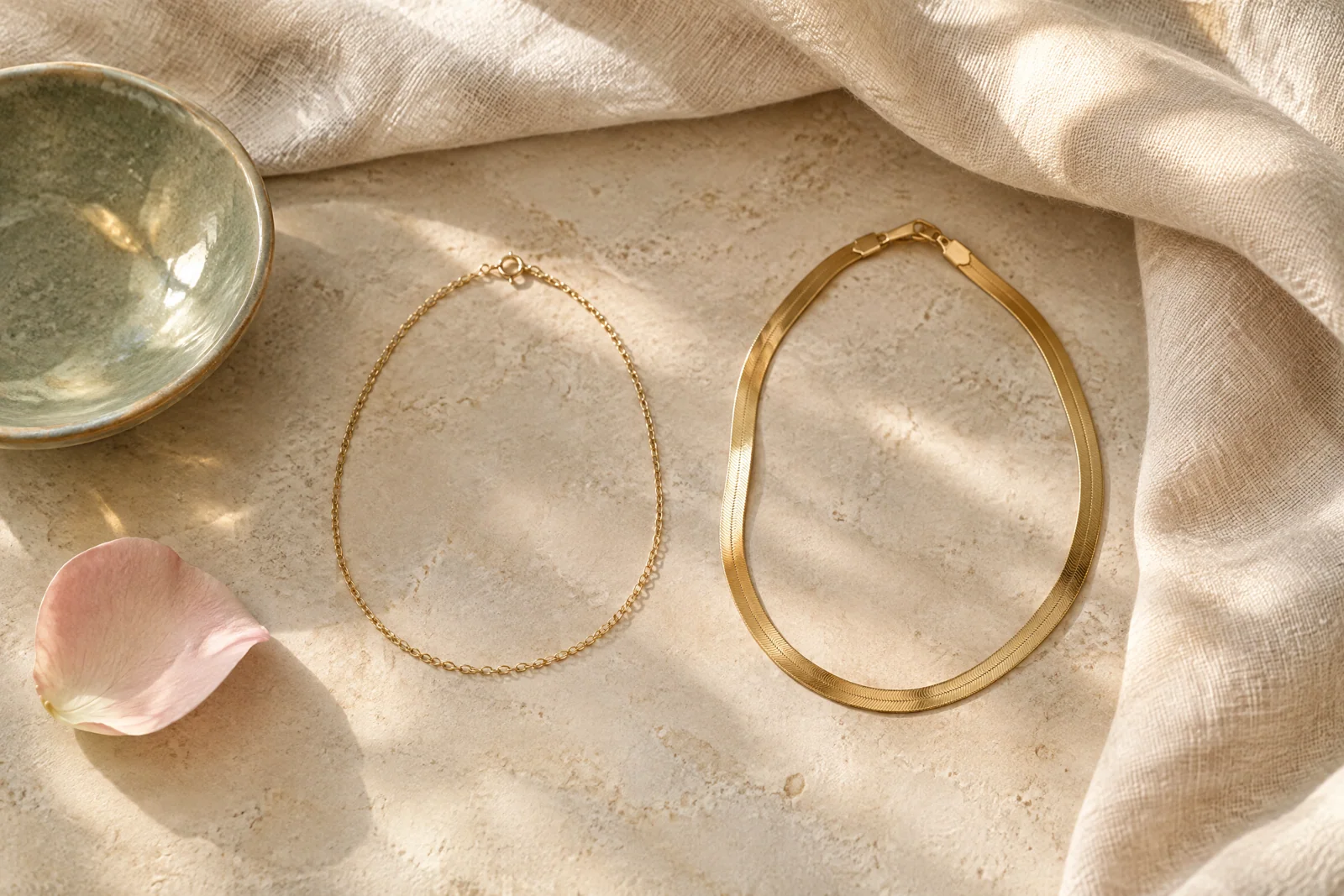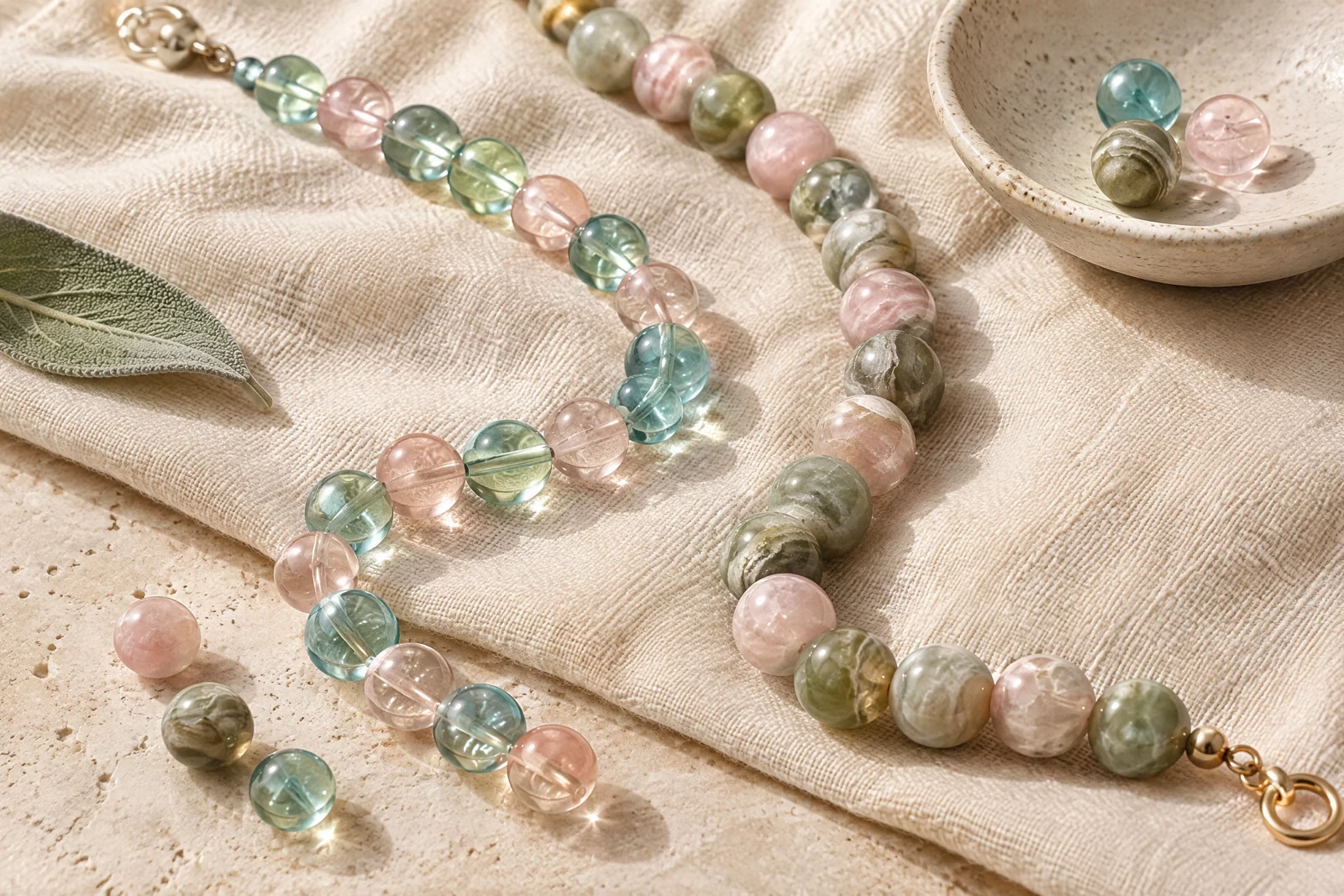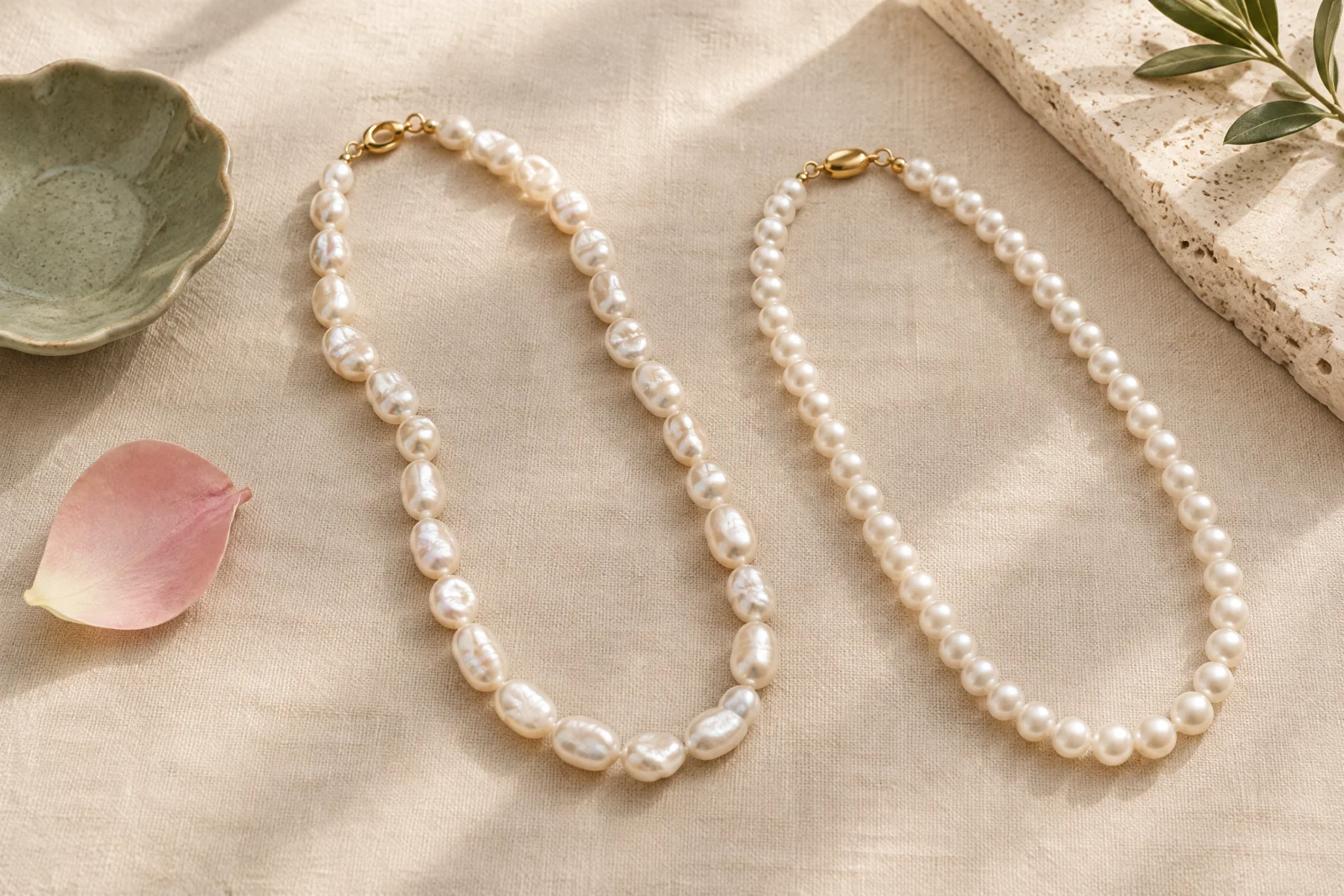
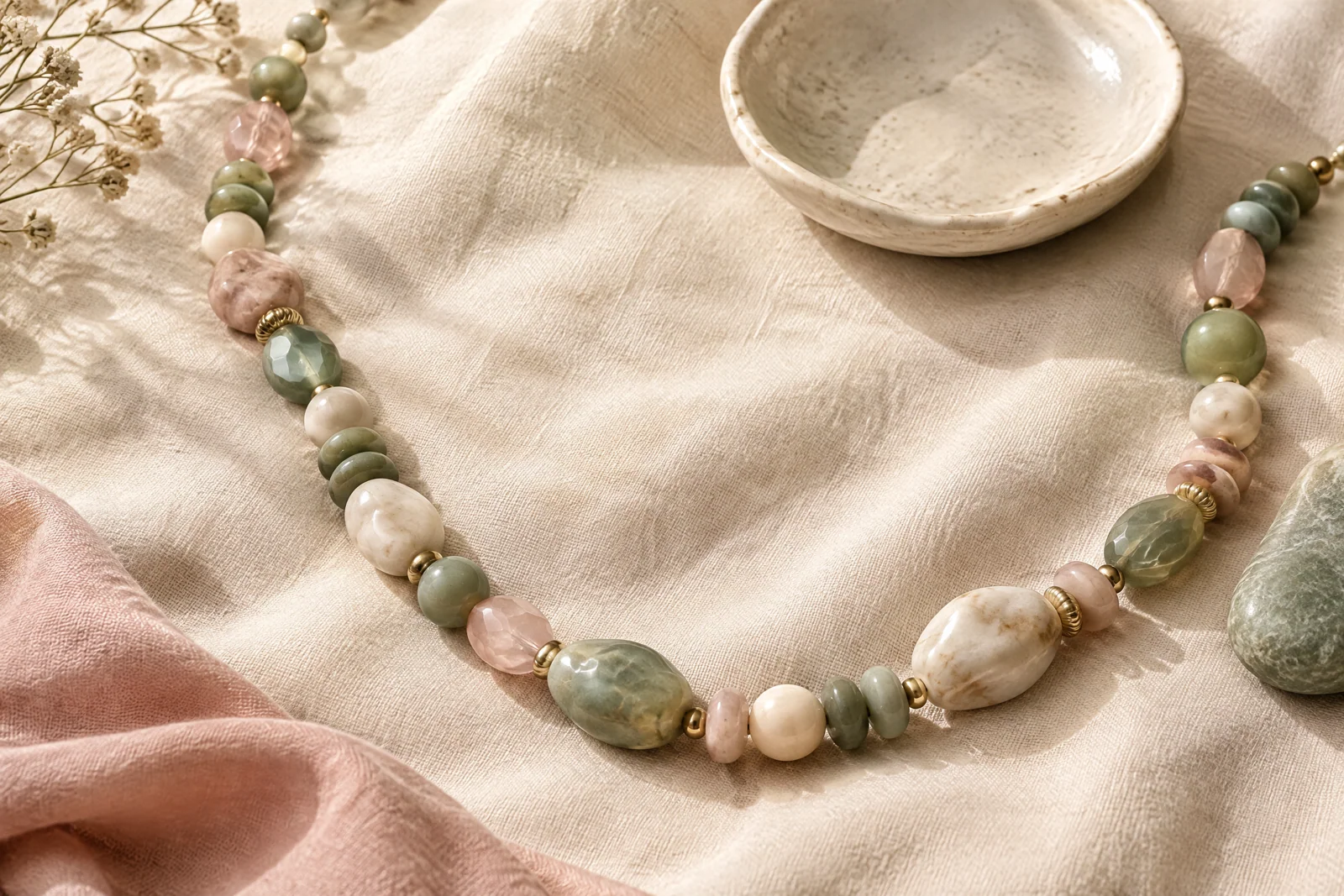
A necklace can use a familiar palette and still feel entirely different when its beads change from round to faceted, oval, or teardrop. That is the quiet power of bead shapes: each silhouette catches light, occupies space, and repeats along the strand in its own way. The result may read polished, playful, relaxed, or dramatic before you notice any clasp or finishing detail.
Understanding bead shapes makes choosing a necklace easier, especially when color alone does not tell the whole story. Think of the strand as a small composition: outline creates its first impression, size sets its visual weight, and surface and spacing give it rhythm. Below, we break down what to look for, with practical ways to style different forms and a few examples from the Duddingtons catalog. For more options, browse our necklace collection.
Start with silhouette: the bead’s outline sets the mood
Among the many bead shapes, round beads are the most familiar starting point because their repeated curves create an even, continuous line. A strand of same-size rounds can look composed and classic; varied sizes give the eye a gentle pulse without losing that softness. Round forms also make a useful counterpoint to crisp tailoring, angular collars, or a graphic print. If your outfit already has strong lines, the curve can keep the overall look welcoming.
Among the bead shapes, rondelles—short, flattened discs—make a different kind of rhythm. Their profile is wider than it is deep, so a strand can appear neatly stacked and close to the neckline rather than like a row of little spheres. Rondelles often read refined and tidy, particularly when their color is quiet or the strand is fine in scale. Wear them with a crew neck or an open shirt when you want detail without a large pendant-like focal point.
Some bead shapes, including ovals, barrels, and elongated forms, stretch the line. Because the eye follows their longer axis, they can make a strand feel directional: vertical when the long forms sit upright, or softly flowing when they lie along the curve. Alternating elongated beads with rounds breaks up the repetition and helps a necklace feel considered rather than uniform. The difference is subtle, but it matters when you want a colored necklace to look elegant rather than overly sweet.
Of all bead shapes, teardrops introduce a clear point and a little movement. Their rounded end gives them softness; the tapered end brings a touch of direction. Depending on how they are strung, teardrops can suggest a botanical, vintage, or more expressive mood. A single drop can act as a focal accent, while many drops form a more noticeable pattern. In the catalog, Mytle combines teardrop beads with patterned rounds, letting contrast in both shape and surface provide interest.
Faceted forms show how bead shapes can have small planes rather than one continuous curve. They catch light in sharper little changes, so a necklace may feel lively or dressed up even in a restrained color. Faceting is not a material description: it describes how the surface is cut or formed, not what the bead is made from. A faceted glass bead and a faceted gemstone bead can differ in material, weight, and other qualities; use the product description to understand construction instead of guessing from the outline.
When considering bead shapes, pay attention to the overall outline from a few feet away as well as the individual bead up close. A necklace of many tiny rounds may read like a colored line; a necklace with a few larger ovals may read as a sequence of focal points. Neither is inherently more formal or more versatile. Ask what you want the silhouette to do beside your face and neckline.
Scale and rhythm: how size changes proportion
Bead shapes and scale work together. A small round bead tends to make a fine, even texture; a large round gives the same silhouette far more presence. An elongated bead can look subtle when slender, but sculptural when broad. This is why it helps to assess bead shapes as a repeated pattern rather than judging one bead alone: the necklace’s visual weight comes from size, number, and spacing all at once.
For a close-fitting neckline, smaller beads can sit comfortably within the space above a crew neck or beneath an open collar. A medium-scale strand can bridge a simple top and a jacket, while larger beads may hold their own against a plain knit or a generous neckline. These are starting points, not rules. The length and placement of the necklace matter too: try it on with the actual neckline if possible, and notice whether the beads land on fabric, skin, or right at a collar edge.
With bead shapes, uniformity creates a steady beat. Repeated beads of similar size and shape feel calm, and that can be especially useful when the color is vivid. A gradual change—from small beads near the clasp to a fuller center, for example—creates a focal point without a separate pendant. Irregular spacing or a mix of sizes feels looser and more individual. If you enjoy an expressive strand but want the outfit to stay balanced, repeat one color elsewhere, perhaps in a scarf, print, or bag.
Consider proportion beside other accessories, too. A substantial necklace often needs less competition at the ears; delicate drops or small studs can let its pattern remain visible. If you prefer a layered look, vary not just length but also the bead rhythm: a strand of rounds alongside a fine chain reads more clearly than two necklaces with nearly identical scale and silhouette. Our earrings collection offers a useful place to compare quieter and more noticeable pairings.
Try a quick mirror test: step back, then cover the necklace with your hand. If the outfit loses its only focal point, the strand may be doing statement work. If its absence barely changes the silhouette, it is likely acting as a supporting detail. Either role is useful; the point is to choose bead shapes and scale intentionally, so the necklace feels in proportion to your clothes rather than accidental.
Surface, spacing, and color: texture completes the story
No bead shapes work in isolation. A glossy round catches a broad, smooth highlight, while a faceted surface breaks that reflection into smaller flashes. A matte or softly patterned bead can feel quieter even when its color is strong. Pairing unlike surfaces—smooth beside textured, opaque beside translucent—adds depth without requiring a busy color palette. With bead shapes, a restrained mix often feels more coherent than changing every feature at once.
Color can amplify or soften how bead shapes read. A saturated hue makes a repeated form easier to read, so a simple strand of rounds can feel graphic. A softer, tonal palette lets shape and texture take the lead. For an easy outfit, echo one shade from the necklace in a small detail rather than matching it head to toe. Warm coral or red can enliven cream and denim; sage, blue, or muted rose can sit gently beside natural linen and soft neutrals.
Spacing is another design decision for bead shapes. Beads touching one another form a continuous, tactile line. Small gaps, knots, or metal spacers add pauses that distinguish individual forms and can make a mixed strand easier to read. Spacers also bring their own color and shine, so treat them as part of the composition. If the necklace mixes metals and beads, use its actual material description as your guide; color alone does not tell you whether a detail is plated, filled, or another material.
A necklace can be interesting without perfect symmetry. Alternating a patterned oval with a round, or placing a distinctive bead just off center, creates an easy focal point. Repetition keeps the design legible; a small variation gives the eye somewhere to land. When evaluating bead shapes, look for a relationship between the forms: shared color, a repeated curve, a consistent finish, or a clear contrast that appears deliberate.
Catalog examples make these choices tangible. Everly is described as mostly round gemstone beads, with some faceted beads and differences in size and texture; similar tones tie those changes together. That is a useful styling lesson: when several shapes share a related palette, the necklace can feel varied without becoming visually scattered. The description also notes that its clasp may be worn at the back or front, creating another small choice in how the details are presented.
Carefully check the product’s stated materials when comparing examples. A visual finish is not enough to identify a bead or determine its care needs. Mixed-material necklaces can combine beads with metal components or other details, and care should suit the more delicate element. For styling inspiration, explore our bracelets collection and notice how repeating a shape or color on the wrist can connect a look without duplicating the necklace.
Choose a shape for the outfit—and wear it comfortably
Start with the outfit’s mood, then select bead shapes that reinforce or gently contrast with it. For a clean, minimal outfit, a strand of evenly sized rounds or slim ovals adds color while keeping the lines simple. For relaxed linen or a soft blouse, a mix of organic forms can feel at ease. With a sharp blazer, try rounds or rondelles for a softer counterpoint, or faceted beads if you want the necklace to echo the outfit’s polish.
For a patterned shirt, let the necklace choose one color already present and keep the bead pattern relatively uncomplicated. If the clothes are plain, the necklace can carry more variation: a sequence of differently sized rounds, a few larger ovals, or a play of smooth and faceted surfaces. When two accessories compete, edit rather than add. Remove one layer, switch to simpler earrings, or move a clasp detail to the back so the front reads more quietly.
Think about how bead shapes move and feel, as well as appearance. Larger or more elongated beads may have a different feel against the collarbone than tiny rounds; the full necklace’s weight and construction matter, not shape alone. Check the listed length and clasp details where provided, and consider how the strand sits when you turn or bend. If the necklace includes components that might catch on a knit, pair it with a smoother fabric or wear it over a top rather than under a collar.
Bead shapes are an especially helpful guide when you are shopping online. Look at both the close-up and the full view: close-ups reveal facets and pattern, while a full view shows scale and the necklace’s overall rhythm. Read the written description for the stated materials, measurements, and length; a photograph can make beads appear larger or smaller depending on crop and styling. Browse all jewelry collections when you want to compare silhouettes across categories, and use those descriptions rather than assumptions to assess a particular piece.
Ultimately, there is no single best silhouette. Rounds are easy to understand and endlessly adaptable; rondelles are neat and understated; ovals add direction; teardrops create a visible point; and facets bring little shifts of light. The most useful bead shapes are the ones that suit how you dress and what feels natural to wear. Try one shape outside your usual preference, or notice which outline you reach for repeatedly. That small observation is a better style rule than any trend forecast.
A final styling check can be simple: does the necklace have enough space around it, does its color work with the outfit, and does the scale feel comfortable for the occasion? If yes, let the beads be the detail that makes a familiar outfit feel personal. Jewelry should invite experimentation, not demand a complicated formula.
Related reading
Keep exploring materials with Gold-Plated vs Gold-Filled Jewelry: A Clear Comparison, Glass Beads vs Gemstone Beads: Color, Feel, and Care, and Freshwater Pearls vs Faux Pearls: What to Know.